The short answer: a bear market has historically been temporary, and stolen money rarely comes back. Here is how thieves get in, and seven ways to make it much harder.
Picture two retirees. Same age. Same $3 million. Same plan.
March 2020. The first one watches a third of her portfolio vanish in five weeks. She hates it. She does nothing. By August, the S&P 500 is back at its old high.
A Tuesday afternoon. The second one's advisor gets an email. Looks like him. Sounds like him. Wire the money to a new account for a land deal. The money moves. Wednesday, it is in three countries. Friday, it is gone.
One had a bad spring. The other had a permanent one.
Think the second story is far-fetched? The real ones are worse.
IN THE HEADLINES
"British engineering giant Arup revealed as $25 million deepfake scam victim"
CNN, May 16, 2024
"Cryptocurrency 'pig butchering' scam wrecks Kansas bank, sends ex-CEO to prison for 24 years"
CNBC, August 2024
Neither loss came from a bear market. Both are permanent.
Everyone is watching for the other kind of loss. Is AI a bubble? When does it pop? Is this 2000? 2008? Both?
Fair questions. We ask them on air every month. Our Bubble Meter still reads Frothy.
So on October 26, with a room full of our clients listening, Mark Hurley got the question straight. Which is the bigger risk to a client's wealth: the AI bubble bursting into a dot-com-style bear market, or cyber theft?
"Not even close," he said. "Cyber theft. Someone steals your money, you're not getting it back." A life trajectory, in his words, changed in a horrible way.
Hurley has spent decades in this industry. He now runs a firm built around that answer. More on him below. His answer is the whole post.
A bear market is a drawdown. A thief is a deletion.
The Scoreboard
Here is the whole post in one table.
|
|
Bear market |
Cyber theft |
|
Do you still own the asset? |
Yes |
No |
|
Does it come back? |
Historically, every time |
Almost never |
|
Who decides? |
The market |
A criminal |
|
Can you prepare? |
Yes |
Yes |
Since World War II, the S&P 500 has survived more than a dozen bear markets. Average drop, about a third. Ugly. Painful. Panican-inducing.
Every one recovered. Average trip back to even, about two years. Dot-com, seven. The financial crisis, five and a half. Long. Brutal. Temporary.
Now the other column.
The FBI logged more than $20 billion in cybercrime losses in 2025. Americans over 60 lost $7.7 billion of it, up 59% in one year. More than 12,000 of them lost over $100,000 each. 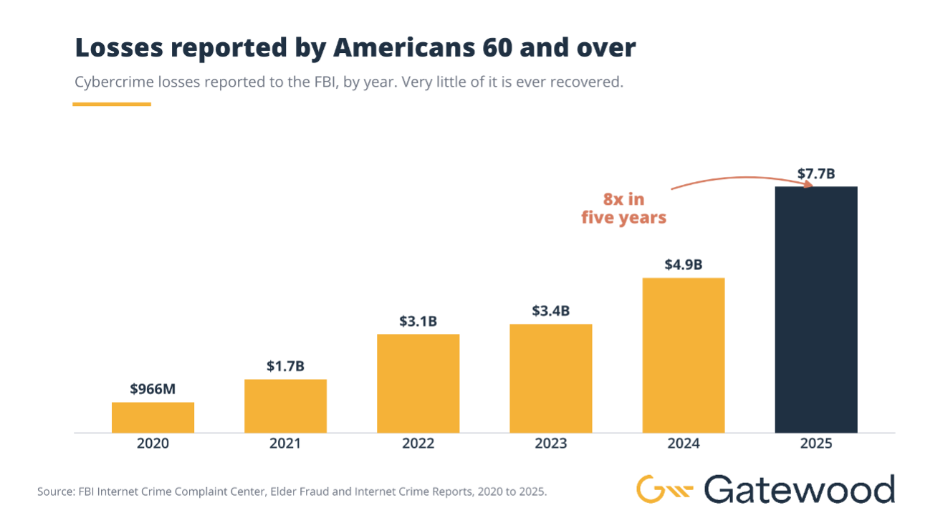
How much came back? In the sliver of elder cases the FBI caught in time, about half the money was frozen. That is the best case. For everyone else, recovery rounds to zero.
A 33% loss that recovers is a bad chapter. A 100% loss that never recovers is the end of the book. 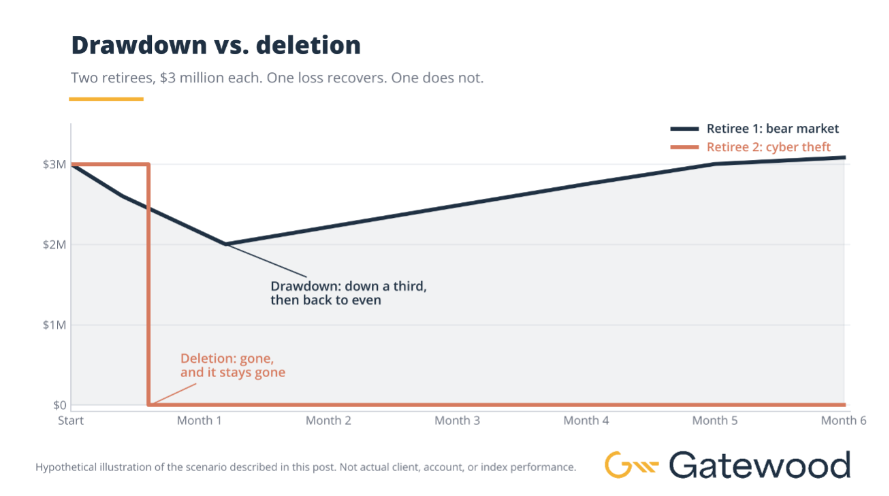
Someone Steals It
I used to file cyber under IT. Firewalls. Passwords. Someone else's department.
Then I spent time with Mark Hurley's firm, Digital Privacy & Protection. It rearranged my thinking.
In late October, we hosted Hurley live for Gatewood clients, plan participants, and our own team. I sat in with a notepad. Most of what follows is what he showed us, checked against the public record.
Hurley founded Fiduciary Network. He wrote the white papers this industry reads and pretends it wrote first. His firm runs on one idea: cyber protection for families, delivered through their wealth manager. Not an IT vendor. The advisor.
In 2024, he and co-authors at DPP, MarketCounsel, and Cyber CIC published Confronting the Realities of Cyber Threats. It was written for people who run firms like ours. Anyone with money at a firm like ours should read it.
Will Your Custodian Reimburse You If You’re Hacked?
Hurley opened with the sentence every client needs to hear and no advisor wants to say: "You could lose a lot of money, and you are not going to get it back."
His one-line version of the problem: "Cybercrime is a $10.5 trillion business. Bigger than drugs." The paper behind it adds a footnote: bigger than every illegal drug sold on the planet, combined.
The paper calls wealth managers and their clients "compelling targets." Not possible targets. Compelling ones. And it quotes a former FBI director: there are two kinds of companies, those that have been hacked and those that will be.
Then the part that stopped me cold.
The authors read the account agreements clients sign with custodians. The wording varies. The pattern does not. You carry most of the risk of theft from your own account. One agreement releases the custodian if you fail to safeguard a login. Another reimburses only losses that were no fault of the client, then keeps the right to decide what reimbursement means.
Their conclusion: if a custodial account is breached, the stolen money is unlikely to come back, and advisors are going to have to say so. Most clients will be stunned. They assume a custodian works like a bank.
It does not. And a footnote adds that most online banking agreements push the same risk onto you.
Hurley's slide on the point put four big banks and four big custodians side by side under one heading: if you are breached and money is stolen, you may not be reimbursed. His advice fit in two lines. Check your account agreements. Read the fine print.
Here is what that looks like in real life.
In 2024, a retired couple in Los Angeles County, 84 and 76, sued one of the largest custodians in the country. A pop-up on the husband's computer warned that his accounts were under attack. He called the number on the screen. The "employee" who answered knew his holdings in detail and told him to move the money somewhere safe. Over two months, roughly $22 million in stock was sold. $18.5 million ended up in crypto wallets controlled by scammers. The custodian's response: the family authorized every wire, and every wire went to an account the family controlled.
Read that twice. That is the fine print in action. The money left with his own signature on it.
The rare wins take years. In September, a FINRA arbitration panel ordered a major custodian to pay a family $1.34 million after three wires left an elderly client's trust account for a crypto exchange. The family sued in 2024. The client died before the award. The custodian says the panel got it wrong. The panel itself split two to one.
Two years. A lawsuit. A dissent. That is what winning looks like. Most families never get that far.
How Do Scammers Actually Get to Your Money?
They do not crack your custodian. Too hard. The paper is blunt: the easiest way into a wealth management firm runs through its clients and its people working from home. One study found 82% of financial services breaches started with someone working remotely.
So they come for you. The headlines show exactly how.
They fake the people you trust. In early 2024, a finance employee at Arup, the engineering firm behind the Sydney Opera House, got an email asking for a confidential transfer. He suspected phishing. Then he joined a video call with the company's CFO and several colleagues. Every one of them was a deepfake. He made 15 transfers totaling HK$200 million, about $25.6 million. Gone.
They fake the boss. Six months later, a Ferrari executive got WhatsApp messages from a new number with CEO Benedetto Vigna's photo on it. Then a live call in Vigna's voice, accent and all, about a confidential deal that needed a currency transaction. The executive heard something slightly mechanical in the voice and asked one question: what was the title of the book you recommended to me last week? The caller hung up.
IN THE HEADLINES
"Ferrari exec foils deepfake attempt by asking the scammer a question only CEO Benedetto Vigna could answer"
Bloomberg via Fortune, July 27, 2024
Remember that question. It is the whole defense, and it costs nothing.
They steal your phone number. January 9, 2024. The SEC's official account on X announced that bitcoin ETFs had been approved. They had not. A 25-year-old in Alabama had walked into a phone store with a fake ID, taken over the phone number tied to the account, and used it to reset the password. Bitcoin jumped a thousand dollars and fell two thousand. He got 14 months. If the SEC can be SIM-swapped, so can you.
They watch you type. Hurley showed a slide on shoulder-surfing crews working bars and restaurants. One watches you tap in your passcode. A partner distracts you. The phone is gone, and with the passcode they reset your Apple ID or Google password. Every account behind it is now theirs. The Wall Street Journal's Joanna Stern documented the same crews in 2023: one victim's Apple ID was changed within three minutes of the theft, and a 12-person ring in Minnesota took about $300,000 from 40 victims. Hurley's estimate for a working crew: $50,000 an hour and up.
They come to your house. In a case Hurley walked through, criminals built a profile of a woman from her online footprint, posed as Treasury and FTC officials, and collected her assets face to face in two states. Common enough that the FBI now tracks it as its own category: about 725 complaints last year, $311.8 million in losses, from scammers sending couriers to pick up cash and precious metals from victims of tech-support and government-impersonation scams. Government impersonation alone cost Americans over 60 $413 million in 2025.
They don't need you to be careless. They need you to be human. In 2023, the CEO of a Kansas community bank got pulled into a crypto "investment" by someone he met online. When it needed more money to unlock, he wired $47.1 million of the bank's funds in 11 transfers. The bank failed. He got 24 years. If a bank CEO can be walked into wiring $47 million, your 79-year-old uncle can be walked into wiring $47,000.
And they are already inside the industry. In early 2026, a cyber-extortion crew hit at least two national wealth management firms and claimed millions of client records. Names. Social Security numbers. Account details. Raw material for every scam above.
One more thing. The old safety net, "my advisor will call me to confirm," is weaker than it was. SIM swapping, the trick used on the SEC, rose nearly 400% in three years. If they own your number, they answer that call.
Your 30-Minute Defense
The paper calls it a personal digital protection structure. Hurley splits it in two. Cybersecurity: keeping thieves out of your accounts. Cyberprivacy: keeping your information out of their hands in the first place. You need both. Most people do neither. For a family, it comes down to seven moves. Every one would have changed a headline above.
Separate the keys. A password manager. A different long, random password for every account. Why? A retailer gets breached. Your email and password land in a file. Software tries that password, and every variation of it, at every bank, custodian, and phone company in the country. Reused it? They are in. And short passwords fail on their own. Hurley put up a brute-force table from Hive Systems. Eight characters with letters, numbers, and symbols: about one second. Twelve: eight months. Eighteen: 79 billion years. Length is the whole game. Multi-factor authentication everywhere. And let the manager do the typing. Fake login pages built to look like your custodian's exist to harvest what you type. A password manager will not fill a password into a site it does not recognize. 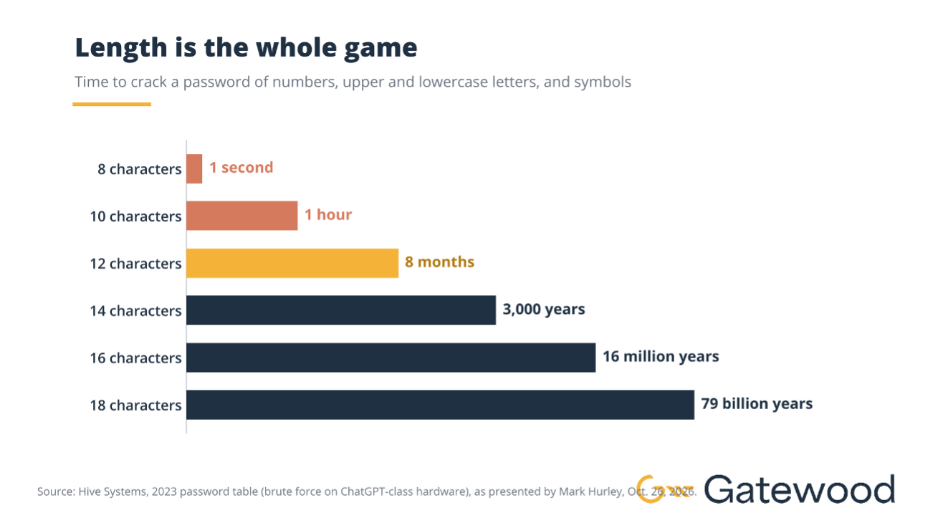
Get a burner email for money. An anonymous address with no link to your name. Use it only for financial accounts and login codes. If they cannot find the email, they cannot reset the password.
Lock down the house. Unique passwords on your Wi-Fi and every device on it. Doorbell. Thermostat. TV. One weak device opens everything behind it. Your kids' devices count. DPP runs classes for children because a teenager's tablet on the home Wi-Fi is the easiest door in the building.
Guard the phone like it is the vault. Because it is. Turn on Stolen Device Protection on an iPhone or Theft Detection Lock on Android. Use Face ID in public instead of typing the code. Make the passcode letters and numbers, not six digits. Carry a USB data blocker, a $10 adapter that lets power through and nothing else. Hurley's warning: plug into a public charging station or a rental car without one and you can lose your data and gain a virus in the same minute.
Go dark on social. Every video of you is raw material for a voice clone. CEOs cannot hide their voices. You can. And every app on your phone holds a copy of you. The DPP paper notes a single client file sells for about $1,000 on the dark web. You are not the customer of most of those companies. You are the inventory. Private accounts. Fewer strangers. Fewer apps.
Freeze your credit. Pick a family code word. Watch your deed. Ten minutes online and one conversation at dinner. The Ferrari executive's book title was a code word. If "your grandson" cannot say yours, hang up. Then ask your county recorder about property fraud alerts. Criminals file fake deeds on paid-off houses. DPP monitors title filings for exactly that reason.
Expect moving money to be a hassle. The big one. The one clients push back on. Every case above ran on urgency. The accounts are under attack. The deal is confidential. The money has to move today. So slow it down. Wires go only to a bank account verified in advance. Anything new triggers real verification that takes time, sometimes in person. And in person is not automatically safer. Hurley's victim handed over her assets face to face. If someone comes to collect, that is not verification. That is the scam arriving in person. At Gatewood, if you ask us to send money somewhere new and we make you jump through hoops, that is the system doing its job.
One more thing Hurley's slides made obvious. None of this is a one-time job. His firm runs it as an annual cycle. Review the setup once a year. Lock down every new device. Wipe every retired one. Watch the dark web for your credentials, because most thieves sell them before anyone uses them. Put a date on the calendar and do it again.
None of this is hard. Almost nobody does it. That gap is the risk.
What a Fiduciary Owes You Now
For decades, good wealth management meant three things. A sound portfolio. A real plan. Keeping clients from panicking at the bottom.
Panicans are always wrong. We still believe that. It is still most of the job.
But the risk that can actually delete a family's wealth is no longer a market risk. It is a thief with your phone number, your voice, and your custodian's fine print on his side. A fiduciary who is not addressing that is not doing the whole job.
So treat cyber like asset allocation. Bring resources. Bring a checklist. Bring outside experts. Put it in the annual review, not a footnote in a disclosure. And when a client asks to move money somewhere new, be the firm that slows down.
The AI bubble may pop. It may not. Either way, the market has a long record of getting back up.
The thief does not give it back.
Ask the man who does this for a living. Not even close.
Wealth with Purpose means guarding the purpose, not just the portfolio. That starts with knowing which risks are temporary and which ones are forever.
Sources
- FBI Internet Crime Complaint Center, 2025 Internet Crime Report, April 2026. https://www.ic3.gov/AnnualReport/Reports/2025_IC3Report.pdf
- Digital Privacy & Protection, MarketCounsel Consulting and Cyber CIC, Confronting the Realities of Cyber Threats, September 2024. https://static1.squarespace.com/static/63d44b39cc31ac17cb99b0ce/t/66d70969e4abf769ac23cff0/1725368682190/DPP-MarketCounsel-CICCyber+Confronting+the+Realities+of+Cyber+Threats+083024.pdf
- Mark Hurley, “Protecting Your Family & Wealth From New Cybercrime Tactics,” private session for Gatewood clients and plan participants, October 26, 2026.
- CNN, “British engineering giant Arup revealed as $25 million deepfake scam victim,” May 16, 2024. https://edition.cnn.com/2024/05/16/tech/arup-deepfake-scam-loss-hong-kong-intl-hnk
- Fortune (via Bloomberg), “Ferrari exec foils deepfake attempt by asking the scammer a question only CEO Benedetto Vigna could answer,” July 27, 2024. https://fortune.com/europe/2024/07/27/ferrari-deepfake-attempt-scammer-security-question-ceo-benedetto-vigna-cybersecurity-ai/
- U.S. Department of Justice, “Alabama Man Sentenced to 14 Months in Connection with Securities and Exchange Commission X Hack that Spiked the Value of Bitcoin,” May 2025. https://www.justice.gov/opa/pr/alabama-man-sentenced-14-months-connection-securities-and-exchange-commission-x-hack-spiked
- U.S. Department of Justice, “Former CEO of failed bank sentenced to prison,” August 19, 2024. https://www.justice.gov/usao-ks/pr/former-ceo-failed-bank-sentenced-prison
- CNBC, “Cryptocurrency ‘pig butchering’ scam wrecks Kansas bank, sends ex-CEO to prison for 24 years,” August 2024. [URL needed]
- WealthManagement.com, “In Class Action, Mercer Client Faults Firm’s Data Protection Amid ShinyHunters Cyber Attack,” March 3, 2026. https://www.wealthmanagement.com/ria-news/in-class-action-mercer-client-faults-firms-data-protection-amid-shinyhunters-cyber-attack
- Cybernews, “Pathstone allegedly breached, as attacks on Wall Street escalate,” February 27, 2026. https://cybernews.com/security/shinyhunters-pathstone-data-breach-ransom/
- Financial Planning, “Schwab, crypto, alleged fraud and an elderly couple’s $18.5M loss,” October 24, 2024. https://financial-planning.com/news/suit-schwab-did-nothing-to-stop-18-5m-crypto-scam
- InvestmentNews, “Schwab ordered to pay clients $1.34 million in crypto dispute involving elderly client,” September 11, 2026. https://www.investmentnews.com/regulation-legal-compliance/schwab-ordered-to-pay-clients-134-million-in-crypto-dispute-involving-elderly-client/268163
- 9to5Mac, summarizing The Wall Street Journal’s reporting on iPhone passcode thieves, February 24, 2023. https://9to5mac.com/2023/02/24/iphone-passcode-in-public-dangers/
- Hive Systems, “Are Your Passwords in the Green?” 2023. https://www.hivesystems.com/blog/are-your-passwords-in-the-green
- S&P 500 historical price index. [Source and URL from Chris]
- The Motley Fool, “Elder Fraud and Financial Abuse Statistics.” [Date needed] https://www.fool.com/research/elder-fraud-financial-abuse-statistics/
Important Disclosures:
Content in this material is for general information only and not intended to provide specific advice or recommendations for any individual. Gatewood Wealth Solutions and LPL Financial do not provide legal or tax advice or services.
All investing involves risk including loss of principal. No strategy assures success or protects against loss.
The opinions voiced in this material are for general information only and are not intended to provide specific advice or recommendations for any individual.
This information is not intended to be a substitute for specific individualized tax or legal advice. We suggest that you discuss your specific situation with a qualified tax or legal advisor.