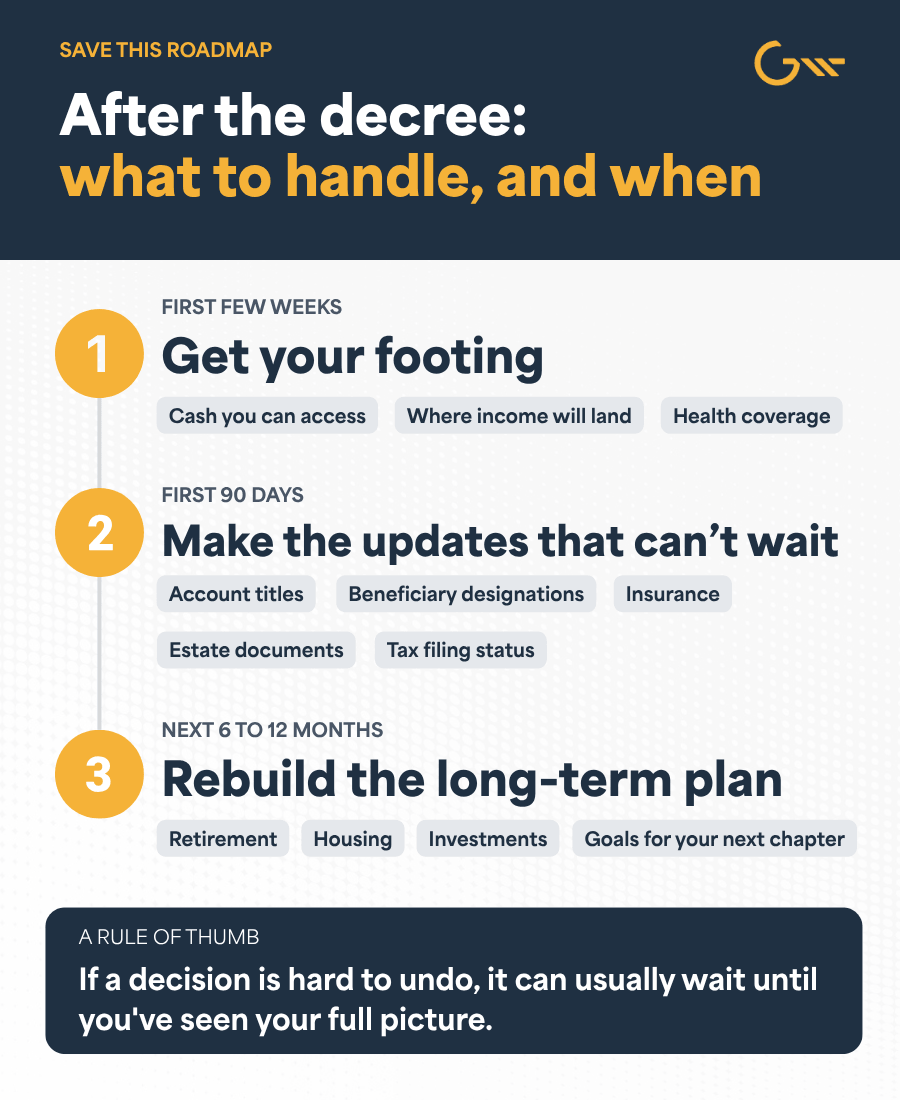
After a divorce is final, financial planning works best in stages:
- First few weeks: get your footing. Confirm how much cash you can access, where your income and any support payments will land, and that your health coverage continues.
- First 90 days: make the updates that can’t wait. These include account titles, beneficiary designations, insurance, estate documents, and tax filing status.
- Next six to twelve months: rebuild your long-term plan. Build it around the life you’re living now, not the one you shared.
None of this happens in a calm, clear-headed vacuum. Divorce often brings grief, anger, relief, and exhaustion, sometimes all in the same afternoon. That’s normal, and it’s the reason for a simple rule of thumb: if a decision is hard to undo, it can usually wait until you’ve seen your full picture.
What needs to change right after a divorce?
Your divorce decree (the court’s final judgment on who receives what) doesn’t update anything on its own. Banks, retirement plans, insurers, and the IRS each need to hear from you. Check the decree first, since it may require you to keep certain things in place.
- Accounts and credit. Separate joint accounts and confirm that accounts awarded to you are now in your name. If your ex keeps the house, make sure your name comes off the mortgage, not just the deed; lenders aren’t bound by your decree. Check your credit report, and if most of your credit history was joint, open a card in your own name to start building it.
- Beneficiary designations. These forms decide who inherits your retirement accounts and life insurance, and they generally override your will. Don’t count on state law to remove your ex automatically: it doesn’t apply to most employer plans, like 401(k)s, where the form on file controls.¹
- Insurance. If you were on your ex’s employer health plan, COBRA generally lets you keep that coverage for up to 36 months, but you or your ex must notify the plan within 60 days.² Review life and disability coverage, too, especially if you now rely on your own income.
- Estate documents. Update your will, powers of attorney, health care directive, and guardians for minor children. Your attorney drafts these documents, and a planner can help everything line up. Learn more about how that coordination works on our Estate Planning page.
- Taxes. Filing status is based on December 31: if your divorce is final by then, you’ll file as single or head of household for the whole year. Alimony under agreements finalized after 2018 generally isn’t taxable to the recipient, and child support never is.³
How are retirement accounts divided in a divorce?
Your decree says how retirement accounts will be split, but a separate step actually moves the money. For a 401(k) or pension, that’s a court order called a QDRO (qualified domestic relations order). For an IRA, it’s a direct transfer. Either way, the split isn’t finished until the money is in an account in your name. Ask your attorney who is handling it, and follow up until you have confirmation.
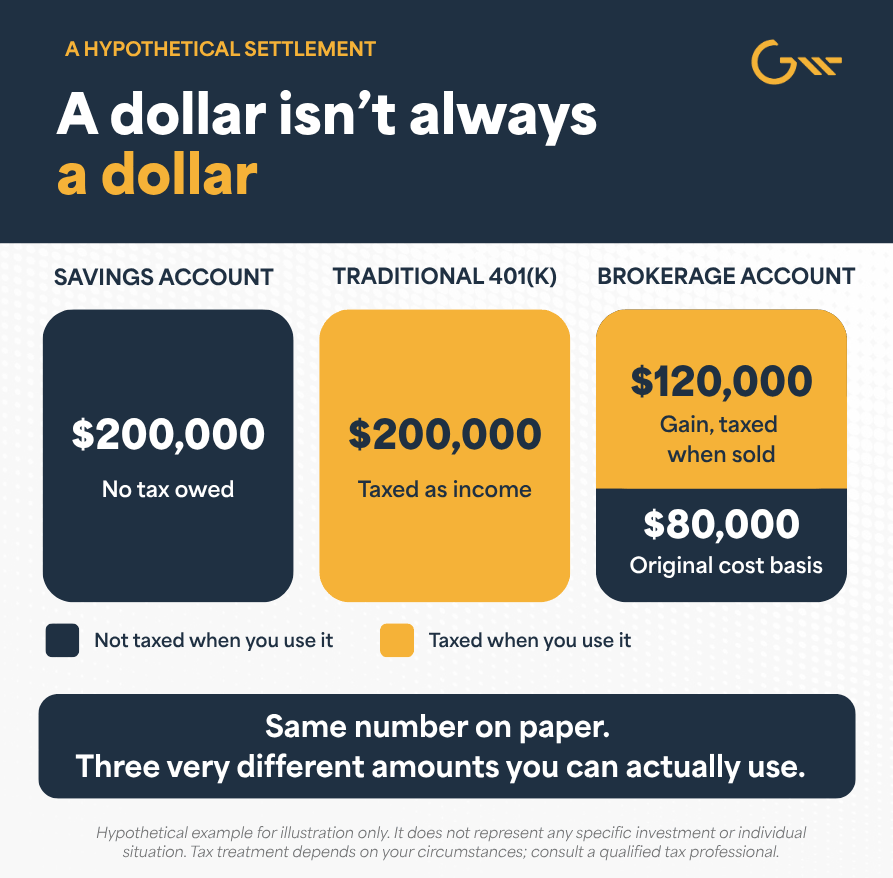
It also helps to know that a dollar isn’t always a dollar. $200,000 in savings, $200,000 in a traditional 401(k), and $200,000 in an investment account can leave you with very different amounts after taxes. Retirement withdrawals are taxed as income, and investments you receive keep their original cost basis, which can mean a taxable gain when sold.³ That matters most while a settlement is still being negotiated.
How do I rebuild my financial plan after divorce?
Start with four questions:
- What do I own and owe now? List every account and debt, including how each will be taxed.
- What does my life cost now? Build a budget from your new costs, and note when any support payments will end.
- How much cash should I keep on hand? While things settle, a larger cushion than usual can keep a surprise bill from becoming debt.
- Am I on track for retirement? Revisit your timeline, and check Social Security. If your marriage lasted at least 10 years and you’re unmarried and 62 or older, you may qualify for benefits based on your ex’s work record without reducing theirs.⁴
Together, those answers become the foundation of your new financial plan: a monthly spending plan, a cash reserve target, an investment strategy, updated retirement projections, and a list of account, insurance, and estate-planning changes that still need to be completed.
What if my spouse handled the money during our marriage?
That’s common, and it isn’t a failing.
Start with a simple map of every account and how to access it, then set aside a regular time each week to review. Ask every question, even the ones that feel basic.
If you’re choosing an advisor, ask how they’re paid and what your first 90 days together would look like; a good one will answer plainly and in writing. And be cautious with anyone who offers to take it all off your hands. Real help explains; it doesn’t rush.
Still going through a divorce? What to gather, and what not to decide yet
Gather recent tax returns, pay stubs, account statements, benefit summaries, debt records, and insurance policies. Some states limit changes to accounts and beneficiaries while a divorce is pending, so talk to your attorney before moving money.
Then give yourself time on the decisions that are hard to undo:
- Keeping the house. Run the numbers on one income first. As a single filer, you can generally exclude up to $250,000 of gain when you sell, versus $500,000 for a married couple filing jointly.⁵
- Accepting assets at face value. Compare them after taxes.
- Signing anything you don’t fully understand. “I need a few days to review this” is a complete sentence.
How can a financial advisor help after a divorce?
A financial advisor’s role is to bring structure to decisions that can feel overwhelming. That can include:
- Modeling settlement options side by side if your divorce is still in process, so you can see how each could affect your cash flow and retirement over time
- Organizing everything you own and owe into one clear picture
- Projecting your cash flow and retirement on your new income
- Coordinating with your attorney and CPA so account titles, beneficiary forms, and estate documents all point in the same direction
At Gatewood, our Firm-to-Family® model means you have a team behind you, not a single advisor. Divorce is one of life’s hardest transitions, and our goal is to walk alongside you through it: listening first, moving at your pace, and staying with you as your new plan takes shape.
Ready to talk it through?
Whether your divorce was finalized last month or several years ago, a conversation can help you see where you stand and what to do next. There’s no obligation, and no pressure to decide anything in the first meeting.
Sources
- Egelhoff v. Egelhoff, 532 U.S. 141 (2001). https://supreme.justia.com/cases/federal/us/532/141/
- U.S. Department of Labor, COBRA Continuation Coverage. https://www.dol.gov/general/topic/health-plans/cobra
- Internal Revenue Service, Publication 504, Divorced or Separated Individuals. https://www.irs.gov/publications/p504
- Social Security Administration, Divorced Spouse’s Benefits (POMS RS 00202.005). https://secure.ssa.gov/poms.nsf/lnx/0300202005
- Internal Revenue Service, Topic No. 701, Sale of Your Home. https://www.irs.gov/taxtopics/tc701
Important Disclosures:
Content in this material is for general information only and not intended to provide specific advice or recommendations for any individual. Gatewood Wealth Solutions and LPL Financial do not provide legal or tax advice or services.
All investing involves risk including loss of principal. No strategy assures success or protects against loss.
The opinions voiced in this material are for general information only and are not intended to provide specific advice or recommendations for any individual.
This information is not intended to be a substitute for specific individualized tax or legal advice. We suggest that you discuss your specific situation with a qualified tax or legal advisor.