Fixed income has been one of the lowest performing asset classes of the past year, and it is negative year-to-date. So why hold bonds when they’re down? Because fixed income was never in your portfolio to outperform stocks. It is there to be the asset you can sell when stocks are falling, so your retirement paycheck doesn’t depend on what the market happens to be doing that month. Judging bonds by their return is like judging a spare tire by its top speed.
We’ve written before about building an intentional strategy for cash. This post picks up where that one left off. Below, we’ll revisit what fixed income is actually doing in your portfolio, how it fits inside Fortress Gatewood, and why the absence of an intentional fixed income strategy can slow you down in the good times and cost you in the bad ones.
Why Do Bonds Look Like Dead Weight Right Now?
Equities are near all-time highs. You open your statement, you see double-digit equity returns over the last year sitting next to a fixed income allocation that is negative year to date, and you ask a fair question: why is that much of my money parked in the thing that isn’t working?
It’s the right question with the wrong measuring stick. Fixed income exists in your portfolio to hold an asset class that swings far less than the broad stock market and to diversify what you own. That’s the theory, anyway. The more useful exercise is to look at what actually happened the last time it mattered.
Fifteen Months and a Fifty-Six Point Gap
The chart below compares the Bloomberg US Aggregate Bond Index against the S&P 500 Total Return Index. Over roughly fifteen months, the S&P 500 fell 50.80% while fixed income gained 5.59%.
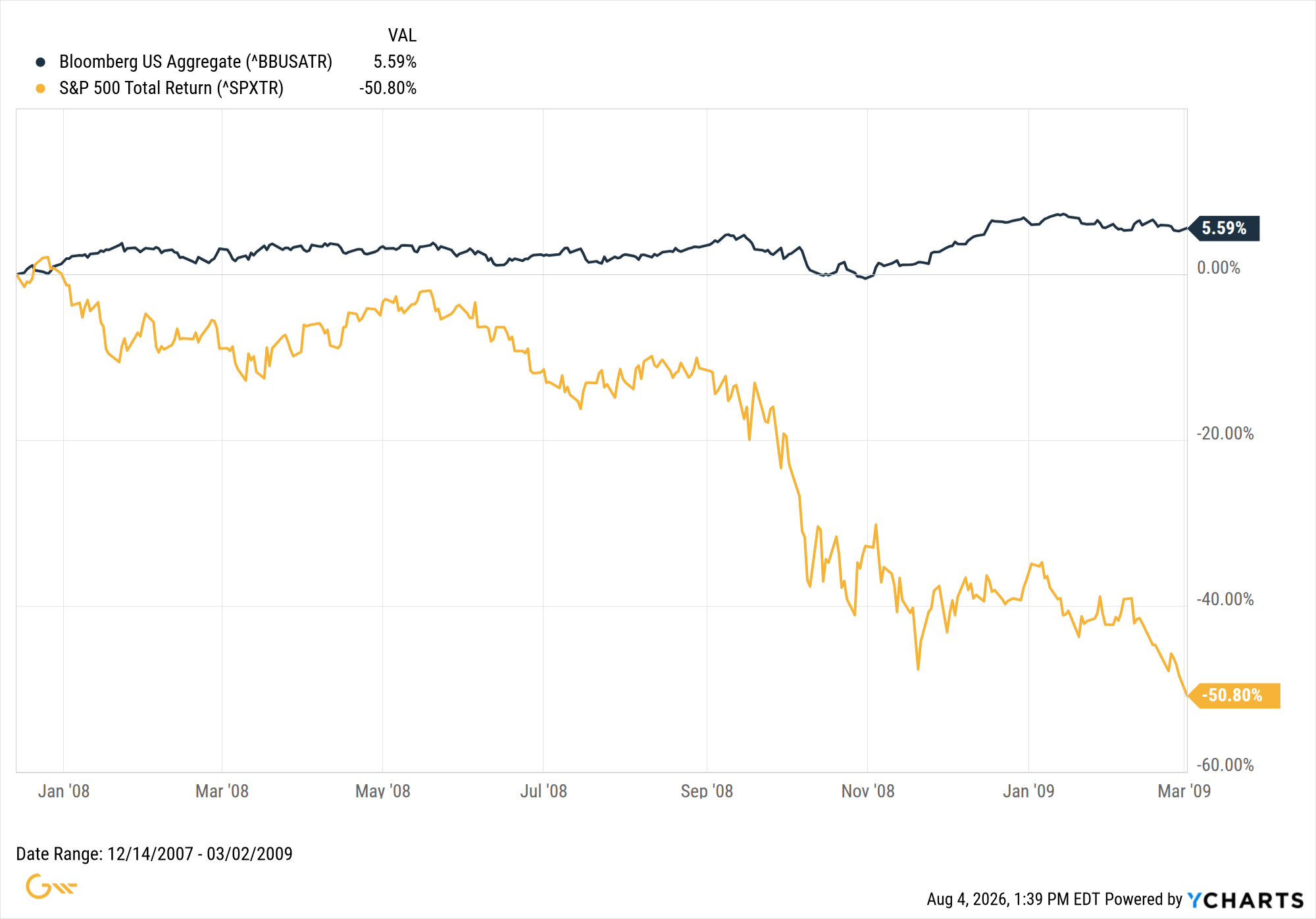
12/14/2007 to 03/02/2009. Source: YCharts, August 4, 2026. Past performance is no guarantee of future results.
Fifty-six percentage points separate those two lines. That gap is the entire argument for holding meaningful years of spending in fixed income before a downturn arrives, because a retiree living off that portfolio has to sell something every month regardless of which line they’re looking at. At Gatewood, we use the fixed income sleeve for the more extended downturns, using cash accounts to cover the immediate downturns, but many individuals not working with Gatewood have to sell each month to cover income needs.
How Long Does It Actually Take the Market to Recover?
Most people picture a recovery as a bad year, maybe two. Zoom out on the same period and a different number emerges. It took nearly five and a half years for the S&P 500 to climb back to its October 2007 peak. Over that same stretch, fixed income was up 37.42% while equities finished the period up 13.20% on a total return basis.
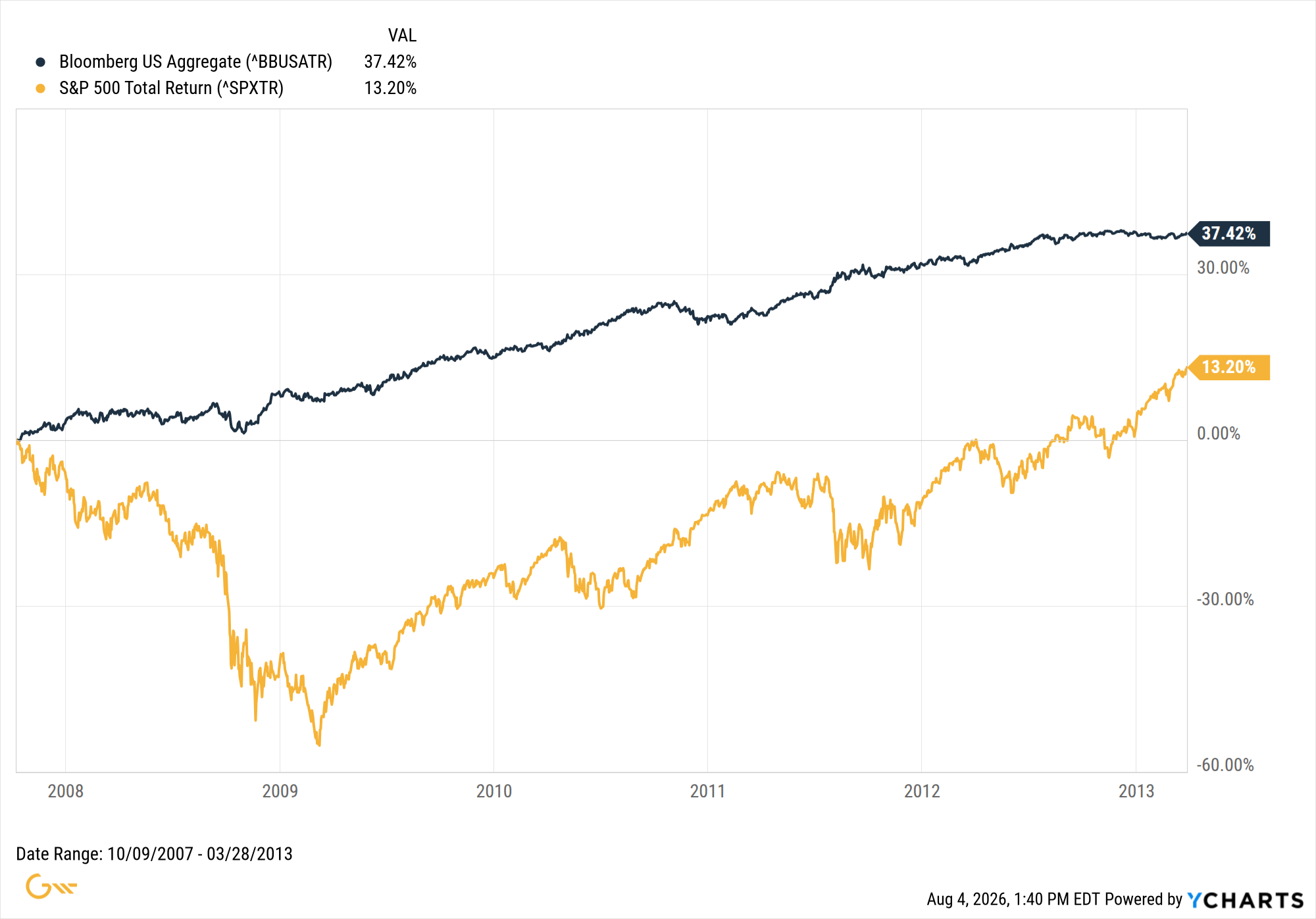
10/09/2007 to 03/28/2013. Source: YCharts, August 4, 2026. Past performance is no guarantee of future results.
Five and a half years is the number that matters here. It is far longer than most people imagine when they hear that markets recover, and it is longer than most portfolios are built to fund without touching equities. Which raises the real question — not whether your portfolio holds bonds, but whether it holds enough of them, in a form you can actually draw on.
Three Moats Around Your Retirement Paycheck
Fortress Gatewood is how we approach portfolio allocation, and it’s an intentional structure rather than an arbitrary split based on your age. We build three moats around a client’s retirement spending needs:
- Moat Ring One is cash, covering short-term spending needs. Target: 24 months of spending.
- Moat Ring Two, our focus today, is fixed income, covering mid-term spending needs. Target: 5–8 years of spending.
- Moat Ring Three is globally diversified equities on a 7–10 year time horizon, positioned to maintain your long-term purchasing power in retirement.
Stack Ring One and Ring Two together and you get something specific: roughly seven to ten years of spending that doesn’t require selling a single share of stock. Set that against a five-and-a-half-year recovery and the design intent becomes obvious. The full walkthrough lives in our Fortress Gatewood one-pager, but today we’re staying inside Ring Two.
A Bond Allocation and a Bond Reserve Are Not the Same Thing
The common approach for a retiree is a static 60/40 allocation, often set by a general risk tolerance questionnaire. It looks balanced on paper. The trouble shows up in how the withdrawals actually get funded, because many portfolios are drawn down proportionally across the entire allocation each month regardless of what the market has done.
That distinction is where a stated bond allocation and a working bond reserve part ways. A portfolio can hold X years of spending in fixed income on paper and still sell equities alongside those bonds to fund a retirement paycheck in a down market. The allocation exists. The mechanism to draw on it selectively is what’s missing.
Where the Number Comes From
When we talk about 24 months of spending in cash and 5–8 years in fixed income, those aren’t figures meant to reassure anyone in a review meeting. They are targets our investment committee revisits every quarter, evaluating where cash hub levels stand across client portfolios and what needs to be replenished. It’s detailed, time-intensive work, and it’s the reason the number means something when a client asks for it. You can read more about how our cash hub strategy works.
Because we don’t run static allocations, a prolonged bear market like the one above doesn’t force a proportional sale across the whole portfolio. Distributions can be funded from Ring Two while equities are left alone, which buys years of room for the recovery to play out rather than months.
The Question Worth Asking at Your Next Review
Downturns test discipline more than they test portfolios. Reacting emotionally to a decline can turn a paper loss into a realized one. A properly sized allocation to fixed income inside Fortress Gatewood is what turns that principle into something you can act on rather than something you nod at.
If you’re a Gatewood client, ask us at your next review exactly where your allocation stands. You’ll get a number, not a philosophy, because the number exists.
If you’re not a client yet, put the same question to whoever manages your portfolio: what is the written plan for funding my income through a five-year bear market without selling my stocks? The specificity of the answer will tell you most of what you need to know.
Important Disclosures:
Content in this material is for general information only and not intended to provide specific advice or recommendations for any individual. Gatewood Wealth Solutions and LPL Financial do not provide legal or tax advice or services.
All investing involves risk including loss of principal. No strategy assures success or protects against loss.
The opinions voiced in this material are for general information only and are not intended to provide specific advice or recommendations for any individual.
This information is not intended to be a substitute for specific individualized tax or legal advice. We suggest that you discuss your specific situation with a qualified tax or legal advisor.
Bonds are subject to market and interest rate risk if sold prior to maturity. Bond values will decline as interest rates rise and bonds are subject to availability and change in price.
The Standard & Poor’s 500 Index is a capitalization weighted index of 500 stocks designed to measure performance of the broad domestic economy through changes in the aggregate market value of 500 stocks representing all major industries.