
When we first wrote about Trump Accounts in December, the program was still largely conceptual. Legislation had passed, the IRS had issued initial guidance, and families were waiting.
Much has changed since then. Tax filing season opened on January 26th, more than three million families have now signed up, a Super Bowl ad ran during the pregame broadcast, President Trump promoted the accounts during his State of the Union address on February 24th and directed the nation to trumpaccounts.gov, and a new online sign-up option just launched.
Here’s our refreshed take on what this program means for your family.
The Basics: What Are Trump Accounts?
Trump Accounts, formally known as 530A Accounts under the One Big Beautiful Bill Act, are a new type of individual retirement account designed specifically for children. They’re custodial in nature, meaning a parent or guardian controls the account until the child turns 18.
How the Trump Accounts Actually Work
- Eligibility: Any U.S. citizen under age 18 with a valid Social Security number can have an account opened on their behalf. Each child may have only one Trump Account.
Account Benefits
- The $1,000 Seed: Children born between January 1, 2025 and December 31, 2028 who are U.S. citizens are eligible for a one-time $1,000 pilot program contribution from the U.S. Treasury. This deposit is expected no earlier than July 4, 2026.
- Annual Contributions: Families, employers, and others may contribute up to a combined $5,000 per child per year. Employers may contribute up to $2,500 (per employee) of that amount under Section 128 as a fringe benefit. The $5,000 limit will be adjusted for inflation starting in 2027. No earned income is required, and contributions don’t affect traditional or Roth IRA limits for the contributor.
Account Limitations
- Charitable & Government Contributions: Qualified general contributions from government entities and 501(c)(3) organizations do not count against the $5,000 annual limit. These are separate and additive.
- Investment Rules: All funds must be invested in low-cost, broad U.S. equity index funds or ETFs tracking qualified indexes such as the S&P 500. Annual fees are capped at 0.10% (10 basis points), and no leverage is permitted.
- No Withdrawals Before 18: Generally, no distributions may be made before the year the child turns 18, with very limited exceptions for death, excess contributions, and certain rollovers.
What’s New About Trump Accounts Since December
1. Tax Season Sign-Ups Are Live
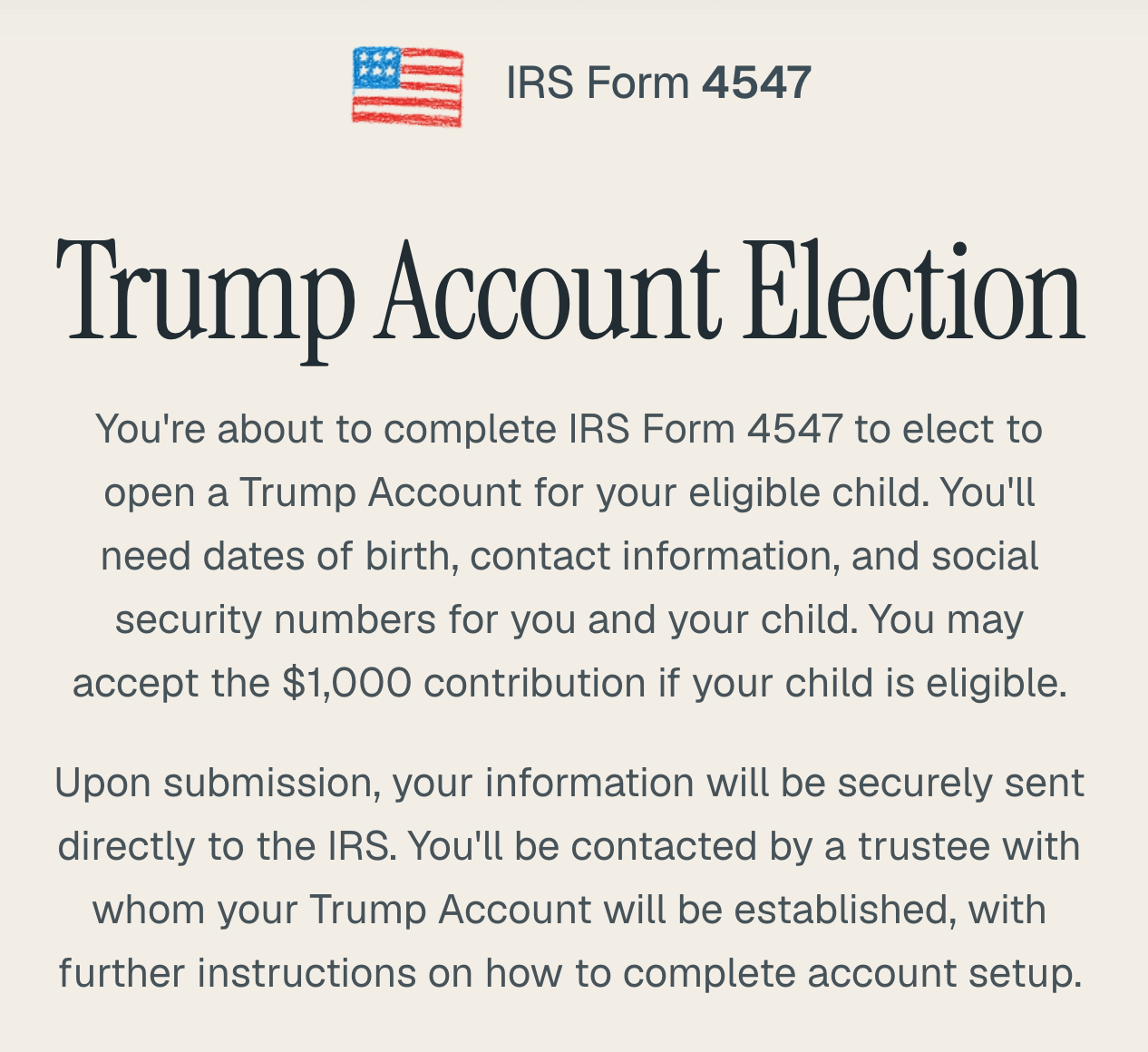
As of January 27, 2026, families can elect to open Trump Accounts by filing IRS Form 4547 with their 2025 federal tax return. The form includes two elections: one to open the account and one to request the $1,000 pilot program contribution (if eligible).
The form accommodates up to two children and families with more eligible children can attach additional copies. Filing electronically with your tax return is the fastest and easiest method.
2. New Online Sign-Up Option
Following the Invest America Super Bowl ad last weekend, a new online sign-up form launched at trumpaccounts.gov, ahead of the originally planned mid-2026 timeline. This gives families a second pathway to open accounts outside of the tax filing process. Here’s what the sign-up experience looks like:

3. Over Three Million Families Have Enrolled
According to the White House, more than three million families had signed up as of the State of the Union address on February 24th. That milestone was up from one million just five days into tax filing season, and Treasury Secretary Scott Bessent noted that approximately 500,000 elections were made in the first three days alone. During the speech, President Trump called the program “something that’s so special” that has “taken off and gone through the roof,” and directed the nation to sign up at trumpaccounts.gov.
4. Activation Timeline
After filing Form 4547, the Treasury Department will contact parents starting in May 2026 to complete an identity verification process and activate accounts. You’ll be contacted by the partner financial firm where your Trump Account will be held with further instructions. Contributions and seed deposits will begin on July 4, 2026.
5. The Dell Foundation Gift
Michael and Susan Dell have pledged $6.25 billion to seed accounts for approximately 25 million children who missed the eligibility cutoff for the $1,000 federal deposit. Their gift provides $250 per eligible child. To qualify for the Dell contribution, children must be age 10 or under, born before January 1, 2025, and live in ZIP codes where the median household income is below $150,000. This is expected to reach children across roughly 75% of U.S. ZIP codes.
An important clarification: The Dell gift goes to a different population than the Treasury’s $1,000. It is not $250 on top of $1,000. Children born 2025 through 2028 receive the $1,000 government seed. Children born before 2025 who are age 10 and under may receive the $250 Dell contribution. Both groups benefit, but through separate funding streams.
6. Growing Employer and Corporate Support
A growing list of major U.S. corporations have pledged matching deposits or contributions for employees. Venture capitalist Brad Gerstner has also pledged $250 for each child under five with a Trump Account in Indiana. We expect this trend of employer and philanthropic participation to continue expanding.
How the Tax Treatment Works
Understanding the tax treatment matters because it affects whether you should add your own money to these accounts or use other vehicles instead.
Think of it in two phases:
PHASE 1: Before Age 18 (The Accumulation Phase)
During childhood, contributions are made with after-tax dollars, and investment growth accumulates tax-deferred. Parents or guardians maintain control of the account during this period. This phase is straightforward.
PHASE 2: After Age 18 (The IRA Conversion Phase)
At age 18, Trump Accounts automatically convert to traditional IRAs. This conversion fundamentally changes how the account functions:
What Changes on Trump Accounts for Those Over 18?
Access and Control: The young adult gains full control as the account becomes a traditional IRA in their name.
Withdrawals and Taxes: This is where it gets important. Distributions are taxed as ordinary income on all earnings and growth (though your original contributions come back tax-free). Additionally, the 10% early withdrawal penalty applies to distributions before age 59½.
The Exception Rules:
The 10% penalty (not the taxes) can be waived for:
- First-time home purchases (up to $10,000)
- Qualified education expenses
- Business startup costs in certain circumstances
Here’s the crucial point many families miss: These “qualified expenses” only waive the 10% penalty—they do NOT eliminate the ordinary income tax on the earnings. Even when funding college or buying a first home, you’ll owe income tax on all the growth.
Investment Flexibility: After conversion, the account can be invested more broadly according to traditional IRA rules, no longer restricted to designated index funds.
- Why This Matters: This automatic conversion to a traditional IRA means families should carefully consider whether contributing their own funds makes sense compared to other savings vehicles like 529 plans (where qualified education withdrawals are completely tax-free) or custodial accounts (where flexibility is greater).
Our General Perspective on Trump Accounts
Accept the free money. If your child qualifies for the $1,000 Treasury seed or the $250 Dell contribution, opening an account is straightforward. You’re accepting a gift with no cost to you. We’d help every eligible family capture this benefit. The Treasury projects that the $1,000 seed alone could grow to roughly $6,000 by age 18, $15,000 by age 27, or over $243,000 by age 55, assuming historical market returns.
Think carefully about your own contributions. For most families whose primary goal is funding education, 529 plans still deliver better tax outcomes. A 529 offers completely tax-free growth potential and withdrawals for qualified education expenses. Trump Accounts tax all growth as ordinary income at withdrawal, even for education. That’s a meaningful difference.
When Trump Accounts Make Sense for Your Plan
That said, Trump Accounts can make sense when:
- You’re already maximizing 529 contributions and want additional tax-advantaged savings
- Your priority is very long-term wealth building, with retirement savings starting at birth
- You’re targeting a first home down payment for your child
- Your employer is offering matching contributions, which is additional free money worth capturing
- You want to diversify across savings vehicles with different tax treatments
Check with your employer. A growing number of companies are pledging contributions to Trump Accounts as an employee benefit. If your employer is participating, that’s money you don’t want to leave on the table, similar to a 401(k) match.
Action Steps for Families
- File Form 4547 with your 2025 tax return. This is the fastest way to open an account and elect the $1,000 pilot program contribution for eligible children. You can also sign up online at trumpaccounts.gov now.
- Check your employer’s plans. Ask your HR or benefits team whether your company is making Trump Account contributions under Section 128.
- Don’t rush your own contributions. Contributions won’t be accepted until July 4. Use this time to evaluate whether a Trump Account, 529 plan, or combination makes the most sense for your family’s goals.
- Keep records. Documentation of contribution sources matters for future distribution taxes and rollover reporting. Start organized from day one.
How Gatewood Can Help You Analyze Trump Accounts
This program launches on July 4, which gives us time to plan strategically together. The questions we help families answer are straightforward but important:
- Does your family qualify for the maximum benefits?
- Should you contribute your own funds, or does a 529 or custodial account better serve your goals?
- And how does this fit into your broader wealth-building strategy?
We specialize in exactly these conversations, the kind where “it depends” actually becomes “here’s exactly what makes sense for you.” We’re fiduciary advisors, so this isn’t about selling you on Trump Accounts. It’s about helping you make the most informed choice for your family’s specific circumstances.
Ready to discuss strategy?

Important Considerations
This program is new, and IRS regulations continue to evolve. The information provided here reflects program details as understood in December 2025, but specific rules and procedures may change as implementation progresses. Investment returns are not guaranteed, and tax laws may change. This material is educational and not a recommendation for any specific action.
For personalized guidance on whether Trump Accounts make sense for your family, we encourage you to consult with a financial advisor and tax professional who can evaluate your complete financial picture.
Important Disclosures
Content in this material is for general information only and not intended to provide specific advice or recommendations for any individual. Gatewood Wealth Solutions and LPL Financial do not provide legal or tax advice or services.
All investing involves risk including loss of principal. No strategy assures success or protects against loss.
The opinions voiced in this material are for general information only and are not intended to provide specific advice or recommendations for any individual. All performance referenced is historical and is no guarantee of future results. All indices are unmanaged and may not be invested into directly.
This information is not intended to be a substitute for specific individualized tax or legal advice. We suggest that you discuss your specific situation with a qualified tax or legal advisor.
Prior to investing in a 529 Plan investors should consider whether the investor’s or designated beneficiary’s home state offers any state tax or other state benefits such as financial aid, scholarship funds, and protection from creditors that are only available for investments in such state’s qualified tuition program. Withdrawals used for qualified expenses are federally tax free. Tax treatment at the state level may vary. Please consult with your tax advisor before investing.
Most 529 plans take a conservative approach to risk. What if being too cautious early on means leaving thousands of dollars on the table?
At Gatewood Wealth Solutions, we believe the key to smarter college savings is compounding earlier—when you have the time—and only dialing back risk when it truly matters. In this post, we walk through our custom 529 glide path and compare it to the most common industry average.
Why Glide Paths Matter in 529 Plans
Glide paths are automated investment changes. In 529s, most glide paths reduce equity (stocks) and increase fixed income (bonds/cash) as the beneficiary enters elementary school. It sounds sensible, but the problem is: these providers reduce risk far too early.
Most Gatewood clients don’t touch 529 money until the first year of college. Even then, withdrawals happen over four years. Many families don’t fully spend the accounts at all—preserving them for legacy planning. If the money is invested too conservatively for too long, it underperforms significantly.
That’s where the Gatewood Glide stands apart.
Our Glide Path
Gatewood’s 529 Glide:
- Starts at 100% equity
- Moves to 60% equity/40% bonds at high school entry (~age 14)
- Drops to 30% equity / 40% bonds / 30% cash at college entry (~age 18)
This gives investors the opportunity to benefit from long-term market growth while still adjusting tactically later if needed.
Glide Path Comparison: Equity Allocation by Milestone
| Plan | Starting Equity | Equity at HS Entry | Equity at College Entry | Avg Equity Allocation |
| Gatewood 529 | 100% | 60% | 30% | 85% |
| Hypothetical Glide 529 | 95% | 30% | 15% | 56% |
Equity Glide Paths

Why It Matters
We are a regulated industry, so publishing expected equity returns can be difficult. However, investors are aware of a consistent equity premium earned in the long run from taking equity risk over fixed income and cash.
Eighteen years is a long-term horizon. We believe that maintaining an average allocation above 80% equity during the growth years aims to lead to better results compared to the typical glide, which tends to average below 60% equity.
Finally, 529 plans are more than just tax shelters. They’re strategic long-term tools. By defaulting too conservative, traditional glide paths underserve many families. At Gatewood, we believe in giving your savings room to grow, with thoughtful transitions when the time is right.
Our 529 strategy reflects how clients really use their plans:
- Continued contributions during high school
- Maintain flexibility around college withdrawals
- Preserve asset for legacy planning
If you’re interested in building a 529 plan that aligns with your goals, we’re here to help.
Building a Better 529 Plan Strategy
Also read: Rethinking the 529: A Legacy Vehicle Hiding in Plain Sight
Explore how 529 plans can extend beyond college savings and support multi-generational wealth planning.
Important Disclosures
The opinions voiced in this material are for general information only and are not intended to provide specific advice or recommendations for any individual.
Investing involves risk including loss of principal. No strategy assures success or protects against loss.
This is a hypothetical example and is not representative of any specific situation. Your results will vary. The hypothetical rates of return used do not reflect the deduction of fees and charges inherent to investing.
Prior to investing in a 529 Plan investors should consider whether the investor’s or designated beneficiary’s home state offers any state tax or other state benefits such as financial aid, scholarship funds, and protection from creditors that are only available for investments in such state’s qualified tuition program. Withdrawals used for qualified expenses are federally tax free. Tax treatment at the state level may vary. Please consult with your tax advisor before investing.
A Quiet Shift with Big Implications
When most people hear “529 plan,” they immediately think “college savings.” And for good reason. These state-sponsored plans have long been the go-to solution for parents and grandparents who want to fund a child’s education while reaping tax benefits.
But a quiet revolution is underway.
Thanks to a series of legislative updates over the past several years—including the Tax Cuts and Jobs Act, both SECURE Acts, and most recently, the One Big Beautiful Bill—529 plans have become more attractive, more flexible, and more expansive than ever. These updates have broadened the definition of “qualified education expenses,” added rollover opportunities to Roth IRAs, and removed financial aid penalties for grandparent-owned accounts. In short: this once narrowly focused tool has evolved into one of the most powerful, tax-efficient investment vehicles available.
The Game-Changer: One Big Beautiful Bill
The One Big Beautiful Bill took things a step further—doubling down on flexibility and long-term planning power. Starting in 2026:
- The annual K–12 withdrawal limit increases to $20,000 per beneficiary, up from $10,000.
- Qualified expenses now include curricular materials, books, tutoring, dual-enrollment fees, standardized test costs, and even certain homeschooling expenses.
- Non-college paths are embraced—vocational training, licensing programs, and professional certifications now qualify, further aligning 529s with the evolving definition of education.
This expansion significantly increases the relevance of 529 plans for families focused on long-term legacy planning. These aren’t just college accounts—they’re a tool to prepare the next generation for any path.
A Multigenerational Strategy in the Making
Imagine this: instead of waiting to pass wealth to future generations through trusts or posthumous bequests, you begin gifting into a 529 plan today. Not just for one child—but for each grandchild or even great-grandchild. Over decades, these accounts provide tax-free growth potential, and can be repositioned for education, vocational training, or even retirement.
And because the account owner can change the beneficiary as needed, the legacy can be sustained for generations.
Final Thoughts
At Gatewood Wealth Solutions, we believe in building Wealth with Purpose. That often means taking a fresh look at overlooked tools—and right now, 529 plans are a hidden gem for legacy-minded families.
Let’s stop thinking of the 529 as a college-only account. It’s time to recognize it for what it really is: one of the most tax-efficient, flexible, and powerful long-term planning vehicles we have.
Related Reading:
A Smarter 529 Investment Strategy
Learn how Gatewood’s custom glide path keeps your education savings aligned with your timeline—not just a default formula.
Important Disclosures:
The opinions voiced in this material are for general information only and are not intended to provide specific advice or recommendations for any individual.
Investing involves risk including loss of principal. No strategy assures success or protects against loss.
Prior to investing in a 529 Plan investors should consider whether the investor’s or designated beneficiary’s home state offers any state tax or other state benefits such as financial aid, scholarship funds, and protection from creditors that are only available for investments in such state’s qualified tuition program. Withdrawals used for qualified expenses are federally tax free. Tax treatment at the state level may vary. Please consult with your tax advisor before investing.
Although many teens are loath to admit it, they rely heavily on advice from trusted adults in their lives—especially their parents. As these teens begin moving out and heading to college, it becomes even more important to set them on a good financial path. Below are seven key pieces of advice every college student should hear from their parents.
You Need a Budget
Encourage your child to create a budget to track their income and expenses. Help them understand the importance of living within their means and prioritizing essential expenses like tuition, housing, food, and transportation.
Avoid Consumer Debt
Without a solid budget, it can be easy to fall into the consumer debt trap—paying with plastic just doesn’t have the same impact as handing over hard-earned cash. With rising costs of food, housing, and college tuition, it’s increasingly easier for young people to take on too much debt when striking out on their own.
Discuss the dangers of taking on excessive debt, including student loans, credit card debt, or personal loans. Encourage your child to minimize the amount they have to borrow at a young age. Your child should also explore any available alternatives, like scholarships, grants, part-time work, or community college, to reduce the need for student loans and credit debt.
Build Credit Responsibly
Teach your child about the importance of building and maintaining good credit. The easiest way to do this is by paying all bills on time, keeping any credit card balances low, and avoiding unnecessary debt. If you have good credit, you can add your child as an authorized user on one of your cards to start building their credit history.
Save for the Future
Encourage your child to start saving for their future goals as early as possible. Discuss the benefits of compound interest and the power of regular contributions over time.
Invest in Career Development
Emphasize the value of investing not just in an education but in a lifelong career. The college years are the perfect time for your child to increase their future earning potential and expand the universe of job opportunities. Encourage your child to explore internships, co-op programs, volunteer opportunities, and networking events to gain valuable experience and skills.
Understand Financial Aid
Teach your child how to fill out the Free Application for Federal Student Aid (FAFSA). Filling out the FAFSA accurately and on time will maximize their eligibility for financial aid. You and your child should also understand their financial aid options, including grants, scholarships, work-study programs, and student loans, so you can make the most informed decisions about the cost of attendance.
Protect Personal Information
Teach your child the importance of safeguarding their personal and financial information, especially Social Security numbers, bank account numbers, and passwords. Remind them to be suspicious about being asked to share information online. Your child can also sign up for programs and services that will monitor their accounts for suspicious activity, including identity theft.
Important Disclosures:
The opinions voiced in this material are for general information only and are not intended to provide specific advice or recommendations for any individual.
This article was prepared by WriterAccess.
LPL Tracking #588335