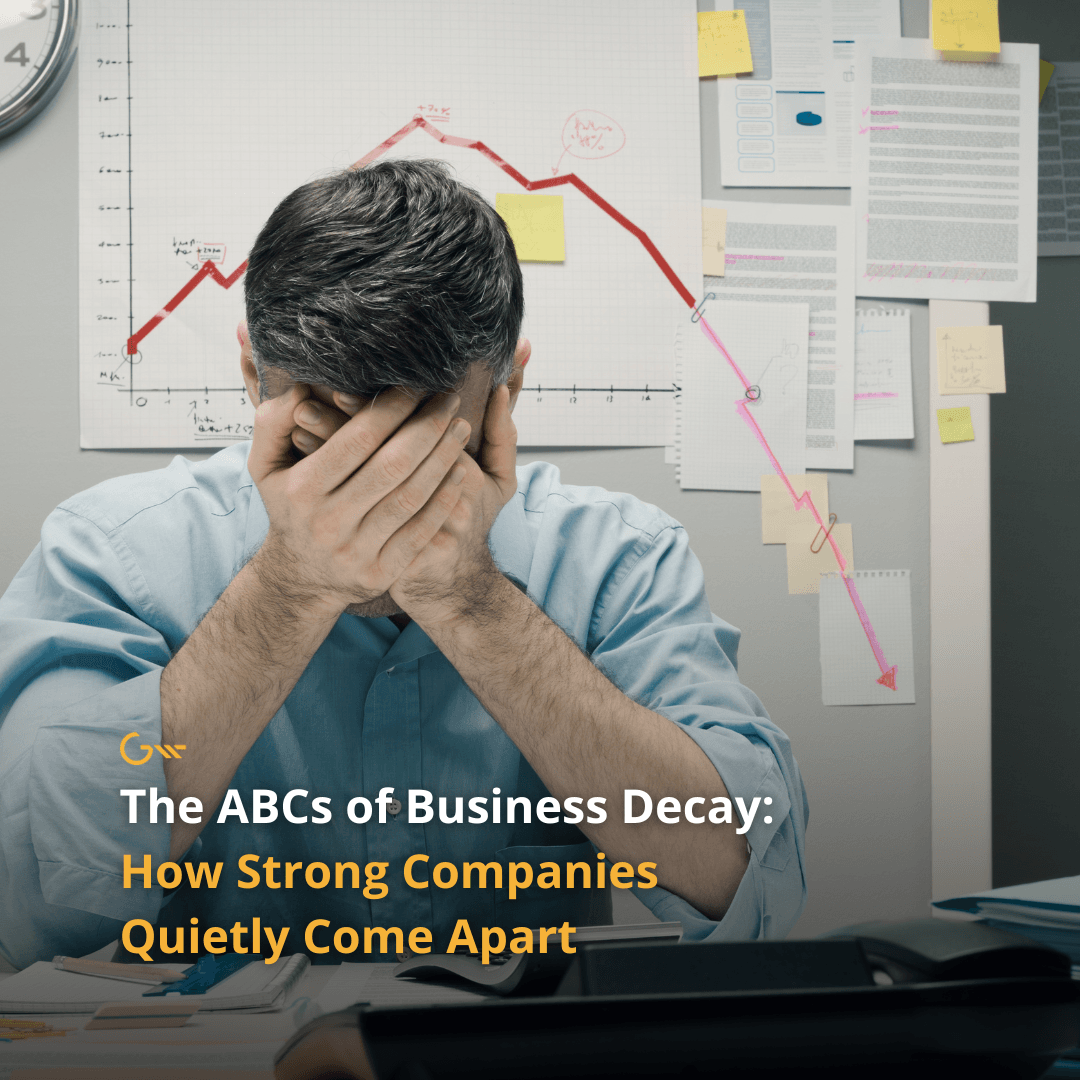
Great companies rarely die in a single dramatic event. They decay quietly, while everything still looks fine. Here is what we are doing about it at the top of a strong year.
Last week our leadership team headed offsite for two days. No clients, no inboxes, no fires to put out. Just the people who run this firm and the business itself laid out on the table in front of us. We do this every quarter, and the point is never to admire how far we have come. The point is to work on the business while it is running well, because that is the only time you actually can.
Here is what was on my mind walking into it. We spend our days telling clients to build their cash reserves when markets are at all-time highs. Not because we think the bear market is coming tomorrow, but because the worst possible moment to prepare for one is after it has already arrived. You raise the reserve when you do not need it. You do the unglamorous work while the sun is out.
So the question I couldn’t shake heading into this retreat was simple: are we doing for our own firm what we ask our clients to do with their portfolios? When the business is healthy, AUM is up, and the wind is at our back, are we using that strength to get ready for the weather we cannot see yet?
That changes what a great quarter is even for. It is not a trophy. It is runway.
The most dangerous thing a strong company can do with a strong year is exhale.
Because great companies rarely die in a single dramatic event. The bankruptcy, the failed product, the scandal that makes the headline, those are usually the last chapter, not the cause. The cause showed up years earlier, quietly, while everything still looked fine.
Where the Framework Comes From
Warren Buffett gave the clearest name to this that I have come across. In his 2014 letter to Berkshire shareholders, he was not writing about strategy or capital allocation. He was writing about character, specifically the character his eventual successor would need. The job, he argued, was not to find the next great acquisition. It was to fight off what he called the ABCs of business decay: arrogance, bureaucracy, and complacency¹. He called them corporate cancers, and his point was blunt. Once they spread, even the strongest companies falter.
I keep coming back to it because all three are disguised as virtues.
A – Arrogance
THE COSTUME OF CONFIDENCE
After a few good years, a leader starts to believe the results were proof of his own brilliance rather than the product of talent, timing, a strong team, and a fair amount of luck. The tell is simple: he stops listening. The people closest to the risk are the people he most needs to hear, and they are exactly the ones an arrogant leader tunes out. Confidence builds companies. The inability to hold that confidence alongside genuine humility is what eventually breaks them.
B – Bureaucracy
THE COSTUME OF DISCIPLINE
It almost always arrives with good intentions. You grow, so you add process. You add process, so you add approvals. And one day you notice that the conversations that used to happen in a hallway now require a form, a meeting, and three sign-offs. The urgency that built the firm is still in the building somewhere, buried under the very structure that was supposed to preserve it. Growth does not have to cost you speed, but it will if nobody is fighting for speed on purpose.
C – Complacency
THE COSTUME OF PRIDE
This is the most dangerous of the three because it feels the most earned. Last year was a great year, so this year’s identity becomes “we are the team that wins.” Ask anyone in sports why champions so rarely repeat. The work that got them to the top gets drowned out by the applause. Complacency whispers that there is nothing left to prove. Real competitors know that is the exact moment the next climb starts.
This is Not Abstract. Look at Our Own Industry.
Wealth management right now is a near-perfect laboratory for all three.
Alternative investment capital has flooded into the RIA space and shows no sign of slowing down. Over the past two years, roughly 89% of deals have been backed by outside capital,² and in recent months institutional buyers have been behind nearly every transaction.³ Valuations have stayed elevated, with top firms fetching a median of around 11.6 times EBITDA⁴ and holding steady rather than cooling off.
And underneath all of it sits a fact almost nobody in this business says out loud: most individual RIAs are not actually growing once market performance is stripped out ⁵. Strip out a decade of cooperative markets, and the organic growth, the net-new clients and assets a firm earns on its own, is flat at a startling number of shops.
That is arrogance, bureaucracy, and complacency wearing pinstripes.
Arrogance is the firm that mistakes a rising market for a winning strategy. AUM is at record highs, revenue is up, and leadership takes a bow for results the index handed them. When you bill on assets, a bull market is the most flattering and most dangerous thing that can happen to you, because it quietly papers over the fact that you stopped growing years ago.
Bureaucracy is what rushes in to fill the vacuum when real growth stalls. Rather than build a genuine client-acquisition engine, firms add committees, layers, and process, then mistake the busyness for progress.
Complacency is the founder who takes the inbound call from an outside buyer and decides the smart play is to coast toward a lucrative exit instead of doing the hard work of building something durable. For a long time, that calculus seemed to work.
But buyers have gotten sharper. They are no longer paying for size; they are paying for durability. What earns the premium now is organic growth net of markets, and the math is unforgiving: every sustainable one-point increase in a firm’s growth rate is worth roughly a seven percent bump in its valuation.⁴ The firms that coasted are about to learn that complacency has a price, and it gets printed right on the term sheet.
Catch the Quiet Rot
What unsettles me about Buffett’s framing is that none of this announces itself. No one circles a date on the calendar as the day the decay set in. It seeps in while the numbers still look good, while the team still feels strong, while everyone is still telling you how well things are going. By the time it shows up in the results, it has already metastasized.
So the real work of leadership is not standing guard against the dramatic failure everyone would see coming anyway. It is catching the quiet rot while it is still small enough to cut out. That requires the one thing arrogance, bureaucracy, and complacency all conspire to take away: the willingness to look honestly at your own company and say where it is starting to soften.
That is the whole point of going offsite. Not to celebrate a good quarter, but to use it. To raise our own reserves while the sun is out.
The question worth sitting with is not whether your business is succeeding. It is which of the three is already working on you.
Where the Conversation Starts
If any part of this resonates, it is probably worth a conversation. Not about the headline risks everyone sees, but about the quieter questions underneath: where growth is actually coming from, how durable it really is, and whether the structure around your business is helping or slowing you down. Those are not always easy to answer from the inside.
At Gatewood, this is the work we do with companies every day, especially when things are going well. If you want an outside perspective on where strength is masking risk or where opportunity is being left on the table, that is where the conversation starts.
Sources
- Warren E. Buffett,2014 Letter to Berkshire Hathaway Shareholders (released February 2015). https://www.berkshirehathaway.com/letters/2014ltr.pdf
- “Want Top Dollar for Your RIA? Buyers Are Looking for More Than Assets,” Advisor Upside via Yahoo Finance, June 2026, citing David DeVoe of DeVoe & Company.
https://finance.yahoo.com/markets/stocks/articles/want-top-dollar-ria-buyers-120000989.html - “RIA M&A Update: Q1 2026,” Mercer Capital, April 2026.https://mercercapital.com/insights/blogs/ria-valuation-insights-blog/2026/ria-ma-update-q1-2026/
- 2026 RIA Deal Room Report, Advisor Growth Strategies (reported via Yahoo Finance).https://finance.yahoo.com/
- “Organic Growth Strategies from RIA Leaders,” WealthManagement.com, June 2026.https://www.wealthmanagement.com/ria-news/ria-growth-strategies-from-the-top
Important Disclosures:
Content in this material is for general information only and not intended to provide specific advice or recommendations for any individual. Gatewood Wealth Solutions and LPL Financial do not provide legal or tax advice or services.
All investing involves risk including loss of principal. No strategy assures success or protects against loss.
The opinions voiced in this material are for general information only and are not intended to provide specific advice or recommendations for any individual.
This information is not intended to be a substitute for specific individualized tax or legal advice. We suggest that you discuss your specific situation with a qualified tax or legal advisor.
Alternative investments may not be suitable for all investors and should be considered as an investment for the risk capital portion of the investor’s portfolio. The strategies employed in the management of alternative investments may accelerate the velocity of potential losses.