The next bear market is not a possibility. It is a certainty with an unknown date. Most of the industry will hand you a slogan when it arrives. We would rather hand you a plan now.
It is July. Markets sit near record highs. Statements look great. Most people are thinking about the beach or the lake, not the volatility index.
This is exactly when our investment committee goes to work.
On July 6, Gatewood’s Investment Committee raised our clients’ Cash Hub Account Targets to 24 months of planned withdrawals from their Gatewood accounts. Back to our core baseline, tailored to each family’s spending. The committee’s read on markets is deliberately neutral: neither significantly overvalued nor significantly undervalued. This is not a prediction of a decline. It is portfolio construction. Nothing forced our hand. That is the point. You build the reservoir in the dry season, not after the drought begins.
Most firms wait. Then the storm hits, and they hand their clients a slogan.
Here is the uncomfortable question for our industry: everyone agrees bear markets are inevitable. Most great advisors also will admit we are past due for a nasty bear market that is paired with an economic recession (these take 5+ years to typically recover to fresh market highs). So why do so few firms have a written, funded, client-specific plan for one?
What a bear market actually looks like
A bear market is not a number on a screen. It is months and sometimes years of watching your life’s savings shrink while every headline screams it will get worse. It is a retiree drawing income from a portfolio that just lost a third of its value. It is the gap between “the market always comes back” and the only question that matters: will it come back in time for you?
History is blunt. The dot-com collapse started in March 2000. The S&P 500 did not find bottom until October 2002. Down roughly 49 percent over two and a half years. It did not reclaim its old peak until 2007. Peak to trough back to peak: more than seven years. The NASDAQ was worse. Down roughly 78 percent, and it waited until 2015, fifteen full years, to see its old high again.
2008 was faster and deeper. The S&P 500 peaked in October 2007, lost roughly 57 percent in 17 months, and bottomed in March 2009. It did not recover its prior peak until March 2013. Round trip: about five and a half years.
Recoveries are historically reliable. Their timing is not. When a bear market brings a recession with it, as both of these did, recovery is measured in years, not quarters. So ask yourself: could your retirement income survive five to seven years without selling a single stock at depressed prices? For most portfolios, the honest answer is no. That is the problem we built our system to solve.
The real risk is not the drop. The drop is historically temporary for anyone who can afford to wait. The risk is being forced to sell while you wait.
What most firms do, and why it quietly fails
The industry has three standard answers to bear markets. Each one quietly hands you the bill for the downturn. And each flaw shows up exactly when it matters most.
The static 60/40 portfolio. Balanced on paper. But draw retirement income from it in a downturn and you are selling into weakness, month after month. That is reverse dollar cost averaging, one of the most destructive forces in retirement investing. In the good years, the same portfolio surrenders serious equity upside. You pay the toll in both directions.
The dividend strategy. Reliable income sounds great, and dividends have their place. But a portfolio built to chase yield sacrifices total return, piles risk into a few sectors, and stays fully exposed to the bear. The check still arrives. The account still falls.
The fixed annuity. Sold as guaranteed security. And it does deliver the feeling, at an extraordinary price: steep fees, opaque terms, surrender penalties, and a structure that often pays the adviser’s commission better than it safeguards your family. Security that expensive is not security. It is a wealth transfer with a calming story attached.
Notice what all three share: a posture. When the bear arrives, the firm placates. Stay the course. Ride it out. This too shall pass. Those are not strategies. They are euphemisms from people who did nothing to prepare, hoping your patience covers their lack of a plan.
The trap almost nobody explains
Dollar cost averaging works beautifully on the way up. Invest a fixed amount on a schedule and the math is your friend: you buy more shares when prices are low, fewer when they are high.
Retirement flips the equation. Now you are withdrawing a fixed amount to live on. When prices fall, you sell more shares to raise the same income.
Run the numbers. A family drawing $10,000 a month from a portfolio at $100 a share sells 100 shares a month. Let a bear knock the price to $60, and the same $10,000 costs 167 shares. Same income. Two-thirds more shares liquidated every single month. And every share sold in the downturn is gone before the recovery arrives. It cannot earn its way back. It is no longer there.
Picture two retirees. Identical portfolios. Identical average returns over twenty years. One hits a bear market in year two and sells equities to eat. The other has reserves, leaves her equities alone, and lets them heal. Same average return. Radically different endings. That is sequence of returns risk, the silent reason some retirements fail that “should” have worked.
Our entire process exists to make sure our clients are always the second retiree.
Where Fortress Gatewood comes from
This is not a theory we cooked up over a weekend. It has a lineage.
Our founder, John Gatewood, was deeply influenced by Nick Murray, the adviser to advisers. In Simple Wealth, Inevitable Wealth, Murray laid down the foundation: a household approaching retirement needs a deliberate reserve of cash and bonds, sized to carry it through downturns without ever selling equities at the wrong time. Faith in the long-term equity story only pays off if you can survive the short term.¹
John made that idea the spine of how we serve families. Chris Arends and I refined and systematized it into what we now call Fortress Gatewood. We laid out the full framework in Fortress Gatewood: Bear Market Ready, Always if you want the complete architecture. The name is deliberate. You do not build a fortress when the enemy is at the gate. You build it in peacetime, stone by stone, so that when trouble comes, the people inside are already safe.
How the system works
Fortress Gatewood runs on four disciplined moves. Together, they change the entire experience of a bear market.
We take profits at all-time highs. When markets are strong, our process harvests gains into the reserve. Not market timing. Not a guess about the top. A rule: strength is when you stock the pantry.
We hold a real cash buffer. Each client’s Cash Hub is funded toward 24 months of planned withdrawals, sized to their actual spending. Cash they can live on without touching a single share, no matter what the market does.
We size bonds for the hard scenario, not the easy one. Behind the cash sits a bond allocation built for the worst case: a bear market with a recession attached and a recovery that takes years. In that world, our clients live on cash and bonds while their equities sit untouched and recover on their own timeline.
We spend the reserve in bad times and refill it in good ones. This is the step competitors skip. When markets fall, clients draw from cash and bonds by design. We never sell equities into weakness. When markets hit new highs, we refill. The cycle repeats. Cash becomes ammunition instead of drag. Equities get the one thing they need most in a downturn: time.
The Fortress Gatewood cycle: harvest in strength, spend in weakness, refill in recovery.
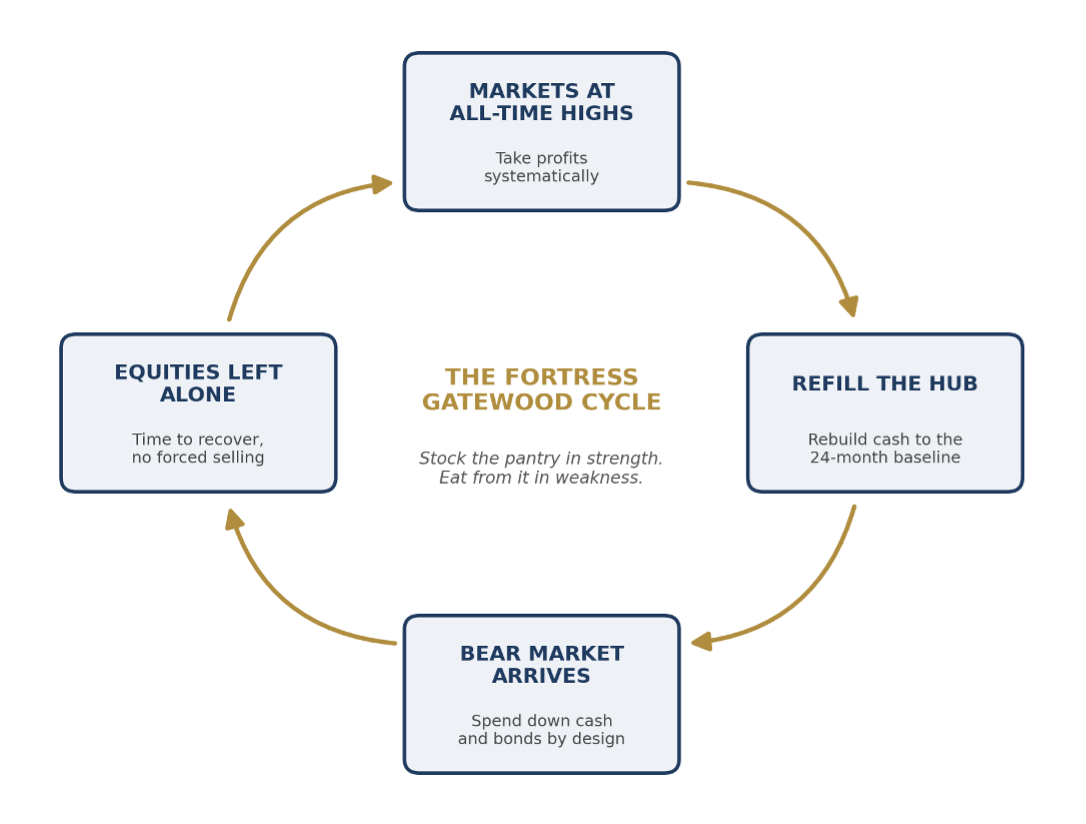
The Fortress Gatewood cycle: harvest in strength, spend in weakness, refill in recovery.
That is exactly what our investment committee did this July: raising every Cash Hub back to the 24-month baseline while markets are calm, funding cash needs through 2027 required minimum distributions. The next time markets are not calm, our families will already be safeguarded.
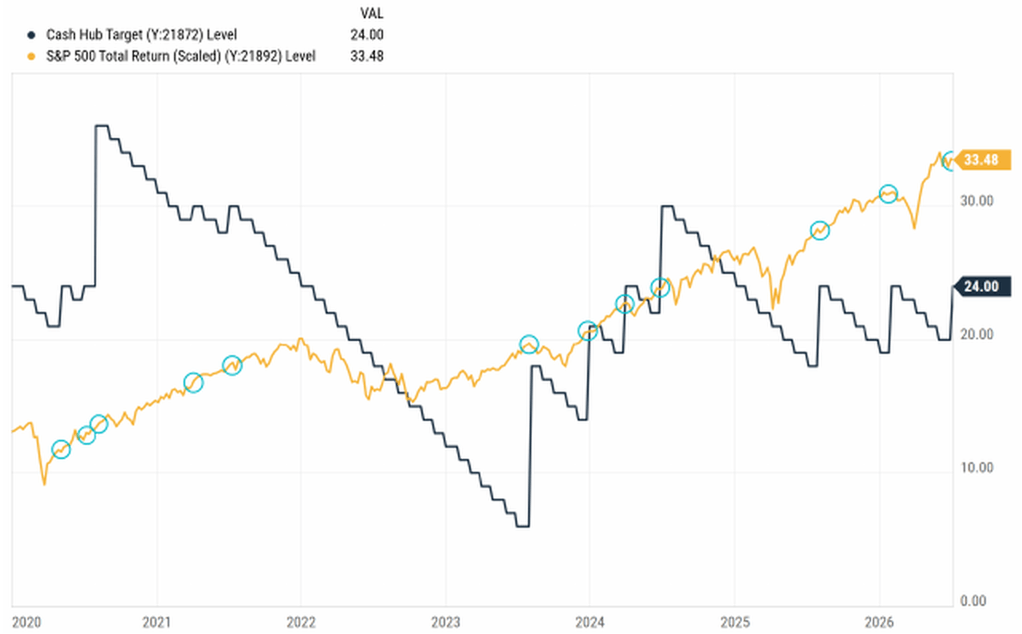
Cash Hub Target in months (navy) vs. S&P 500 Total Return, scaled (gold), 2020 to 2026. Circles show past hub increases. Source: YCharts, July 13, 2026. Shown to illustrate process, not performance.
This is not theory. We have run the play.
When the 2025 correction hit, not one Gatewood family panic-sold. Zero. Not because we predicted anything. Because every family already had a full reserve and already knew the plan. We wrote about it at the time in Zero Panic Selling. Fortress Gatewood: How Our Clients Survived the 2025 Crash and Came Out Swinging.
Go back further. On March 18, 2020, five days before the S&P 500 hit bottom, with the world shutting down and markets in free fall, our CEO Aaron Tuttle, on our Market Insights Broadcast podcast, spoke directly to our clients and walked them through exactly why their income was safe and their equities could be left alone, ready for the recovery. Nobody had to be talked off a ledge. Nobody was standing on one. The fortress was already built.
Two bear-market-grade events. Same system. Same result.
What we talk about in the hallway
Our investment committee’s July memo caught the current balance well. On one side: valuations are elevated after a strong multi-year run, gains are concentrated in a handful of mega-cap names, monetary policy is uncertain in the midst of a Fed transition, and summers before midterm elections tend to get bumpy. On the other: AI-driven productivity gains are still in their early innings, household and corporate balance sheets are healthy, and inflation has cooled. Neither fear nor euphoria. Balance.
We do not own a crystal ball, and we are not calling for a bear market. But our clients ask about the risks they read about, and they deserve straight talk, not silence. So here is what comes up in our hallways and on our client calls.
The demographic super cycle ITR Economics points to for the 2030s: aging populations and structural shifts creating a long headwind.²
A potential AI bubble, where massive infrastructure spending races ahead of real returns and corrects hard. Some call it the most widely forecasted bear market in history. That does not mean it will happen. It does not mean it won’t.
Large-scale technology and cybersecurity risk, the kind of systemic disruption that was hard to imagine a decade ago and is harder to ignore now.
Fresh waves of inflation, fed by a federal government that has shown little discipline on debt under either party.
And the category no one names in advance. Almost nobody had a global pandemic on their list. We lived through one anyway.
This list is not about fear. It is about humility. We hope the next bear market comes without a recession attached. But hope is not risk management. Sober planning means staring at a true worst case, something like the dot-com collapse or 2008, or worse, and building families to withstand it. Prepare for that, and the ordinary downturns take care of themselves.
The real differentiator
We would never claim to be smarter than everyone else in this industry. We claim something harder to copy: we do the work. In advance. Every family. Every cycle.
Most firms treat cash management as an afterthought and bear markets as something to talk clients through after the fact. We treat both as the core of the job: done ahead of time, customized for every family, revisited on schedule whether the headlines are good or bad.
Our clients know we are preparing them for the next bear market during the good times. When it arrives, they will not get soothing euphemisms from a firm that did nothing. They will get a plan already in place, a reserve already full, and a team that did the unglamorous work in the calm so they never have to ride the roller coaster blind.
That is Fortress Gatewood. This July, while the sun is out, we are reinforcing the walls.
If you are a Gatewood client, ask us at your next review exactly where your Cash Hub stands and how your reserve is sized for your family. You will get a specific answer (“You have X years worth of spending in cash and Y years of spending in bonds”), because a specific answer exists.
If you are not a client yet, ask your current advisor one question: “What is your written plan for funding my income through a three-year bear market without selling my stocks?” If the answer is a euphemism, we should talk.
Sources
- Nick Murray, Simple Wealth, Inevitable Wealth. The Nick Murray Company. https://www.nickmurraynewsletters.com/public/Simple-Wealth-Inevitable-Wealth-25th-Anniversary-Edition-2.cfm
- ITR Economics, 2030s Great Depression forecast and demographic research. https://itreconomics.com/2030s-great-depression/
Important Disclosures:
The opinions voiced in this material are for general information only and are not intended to provide specific advice or recommendations for any individual. All performance referenced is historical and is no guarantee of future results. All indices are unmanaged and may not be invested into directly.
Investing involves risk including loss of principal. No strategy assures success or protects against loss.
The economic forecasts set forth in this material may not develop as predicted and there can be no guarantee that strategies promoted will be successful.
Dividend payments are not guaranteed and may be reduced or eliminated at any time by the company.
Bonds are subject to market and interest rate risk if sold prior to maturity. Bond values will decline as interest rates rise and bonds are subject to availability and change in price.
Dollar cost averaging involves continuous investment in securities regardless of fluctuation in price levels of such securities. An investor should consider their ability to continue purchasing through fluctuating price levels. Such a plan does not assure a profit and does not protect against loss in declining markets.
The S&P 500 Index is a capitalization-weighted index of 500 stocks designed to measure performance of the broad domestic economy through changes in the aggregate market value of 500 stocks representing all major industries.