John Gatewood, CFP®, CLU®, is the founder of Gatewood Wealth Solutions and the author of The Listening Advisor.
I have spent forty-five years as a financial advisor, and in that time I have sat across the table from thousands of people and quietly watched thousands of other advisors do the same.
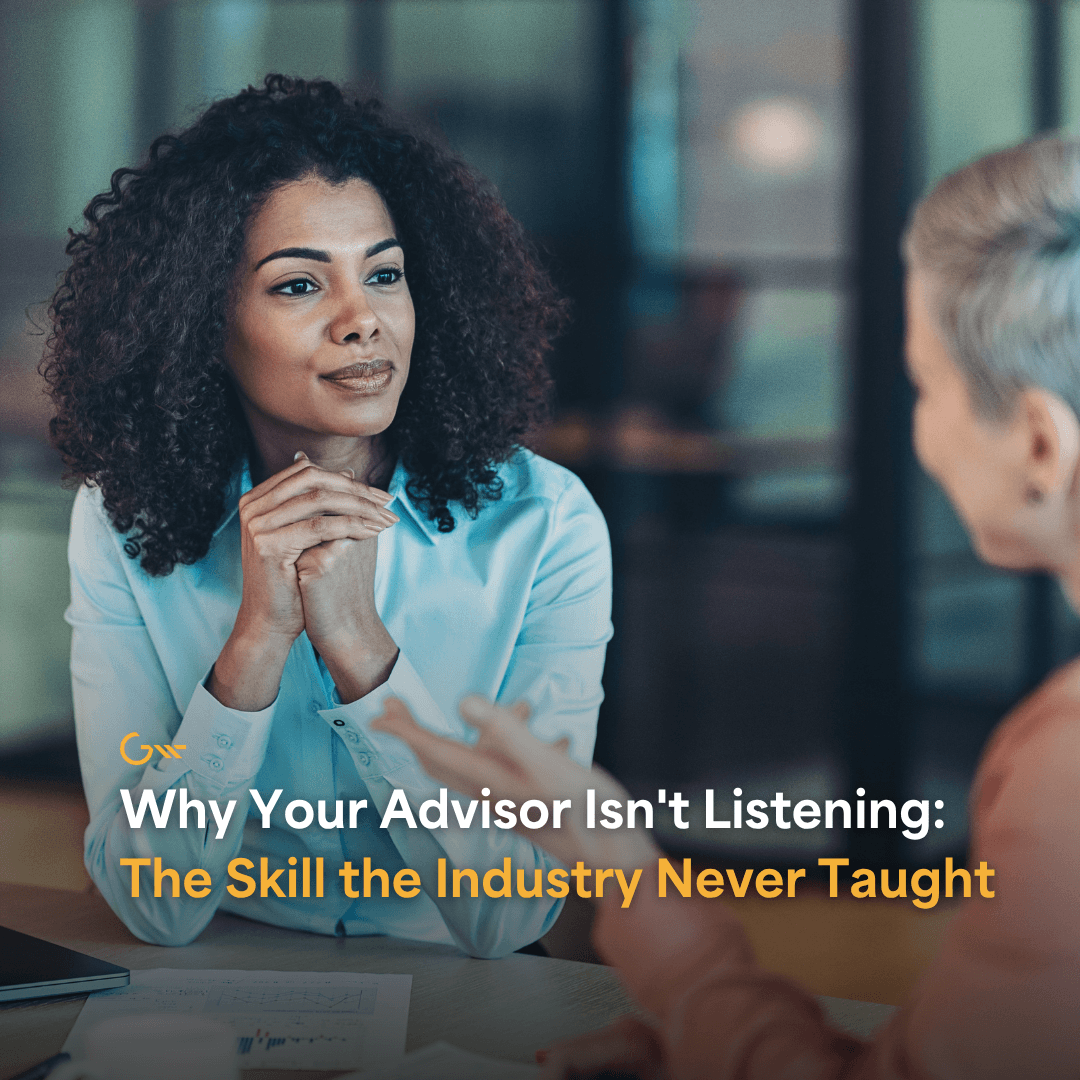
What I have observed, more clearly with each passing year, is a truth that too few people in my profession are willing to say out loud. The reason so many clients feel vaguely unsatisfied with their financial advisor, even a competent one, is not that the advice was wrong. It is that they never truly felt listened to. Their advisor was talking when they should have been listening, explaining when they should have been understanding, and performing expertise when the client simply wanted to feel heard.
This is not a small problem, and it is not the fault of individual advisors who are, by and large, intelligent and well-intentioned people. It is the product of how our entire profession trains its people, and it is the reason I built Gatewood Wealth Solutions around a different idea entirely.
I want to show you what I have learned, why so many advisors are not really listening, and what you have every right to expect from the person you trust with your family’s financial future.
The Profession Trained a Generation to Talk
When I entered this business decades ago, the tools were primitive by today’s standards, and much of an advisor’s value came from knowledge that clients could not easily find on their own.
So the profession built its training around exactly that, teaching advisors to accumulate knowledge, master products, follow compliance, and later, to operate increasingly sophisticated technology. Those things matter, and they always will. A firm that cannot deliver rigorous planning, sound investment management, and airtight compliance has no business managing your money.
But somewhere along the way, the profession mistook all of that for the whole job, and it invested almost nothing in the skill that determines whether a client feels cared for. New advisors are trained relentlessly on knowledge, compliance, technology, and strategy, and almost never on how to listen, how to build trust, or how to make another human being feel understood.
The result is a profession full of advisors who can explain a Monte Carlo simulation in exquisite detail but cannot tell you what their client is actually afraid of. It should not surprise anyone that roughly 72% of new advisors leave the business within a few years, according to Cerulli Associates.¹
They did not fail because they lacked knowledge. They failed because no one taught them how to build a relationship, which is the part that keeps a client for life. There is research that captures this gap with uncomfortable precision. A Horsesmouth survey found that 87% of advisors believed their clients spoke more during meetings² — yet when Jump analyzed nearly 12,000 recorded advisor-client conversations, it found that advisors actually spoke more than their clients in 84% of cases.³
The people whose job is to understand you are convinced they are listening while the recordings show them talking. That is not dishonesty. It is the natural outcome of a profession that trained its people to perform knowledge rather than to connect.
The people whose job is to understand you are often convinced they are listening while the recordings show them talking.
Why This Is About to Matter More Than Ever
For most of my career, technical knowledge was at least a genuine differentiator, because it was scarce and hard to acquire. That era is ending.
Artificial intelligence is rapidly commoditizing knowledge, and within a few short years every advisor and every client will have access to the same powerful tools, the same instant analysis, and the same sophisticated answers. When a client can ask an AI assistant to explain a tax strategy or model a retirement plan in seconds, the advisor whose value rested on knowing more than the client will find they have very little left to offer.
What will remain is how a client feels in the presence of their advisor, whether they feel genuinely known, cared for, and understood, and whether they trust the human being guiding them enough to act with confidence.
Technology and knowledge are becoming the price of admission, available to all. The experience of authentic human connection is the thing no algorithm will ever replicate, and it is the one advantage that has quietly mattered for the entire forty-five years I have been doing this work.
Knowledge Is the Instrument. Connection Is the Music.
Let me offer you the way I have come to think about it. Imagine a world-class orchestra, where every musician holds a finely crafted instrument and reads from the same sheet music. Those things are essential, and without them there is no performance at all. Yet no one weeps in their seat because the violin was expensive or the notation was accurate. What moves an audience is the artistry and the humanity the musicians breathe into those notes. The instrument is necessary, but the music is what people remember.
Financial advice works the same way. Knowledge and technology are the instrument and the sheet music, necessary and non-negotiable, and at Gatewood we insist on the finest of both.
But the experience you actually remember, the reason you stay with an advisor for decades and send your friends and family to them, is the music, and the music is made of authentic human connection.
It is the advisor who listened so carefully that you felt fully understood, who explained things so clearly that you acted with confidence, and who treated you not as an account to be managed but as a person, and a family, to be cared for. Anyone can hand you the instrument. Very few will ever play you the music.
What We Decided to Do Differently at Gatewood
When I built this firm, I refused to accept the industry’s bargain, the one that pours everything into knowledge and technology and leaves human connection to chance.
Yes, we deliver exceptional planning and disciplined investment management, and yes, we invest heavily in the best technology available, because you deserve nothing less. But we do something that remains rare in this profession. We deliberately train our advisors in the skill that matters most, the communication mastery that allows a client to feel truly heard and understood, and we treat that skill as coachable, measurable, and essential rather than as a personality trait you either have or you do not.
What this means for you as a client is a different kind of experience from the start. We want to know you, not just your balance sheet. We want to understand your goals, your family, your worries, and your aspirations, because a financial plan that does not begin with the human being it serves is just a spreadsheet.
We treat the whole family, across generations, because your financial life does not exist in isolation and neither should the care you receive. We listen first, we reflect back what we heard so you know we understood, and only then do we advise, in language clear enough that you can act with confidence rather than confusion. That sequence, understanding before advising, is not an accident at Gatewood. It is trained, practiced, and expected.
Communication mastery has a second half that matters as much as the listening, and it is the discipline of speaking so clearly, so concisely, and so plainly that you truly understand the concepts behind your plan. This is not a courtesy. It is essential, because people fear what they do not understand, and that fear is often the very thing that keeps a client frozen, unable to act on sound advice.
When an advisor buries you in jargon and complexity, they may sound impressive, but they leave you anxious and hesitant. When an advisor explains the same idea in language you can actually grasp, the fear dissolves, the obstacles fall away, and you are finally free to move forward with confidence. Clarity is what turns good advice into action, and helping you act with confidence is the whole point of the work we do.
This is also, if I am honest, the firm I wish I could have built for myself when I was starting out. I learned these lessons slowly, over many years and more than a few mistakes, watching which advisors kept their clients for life and which ones lost them to someone who simply cared more.
Knowledge has always mattered and always will, and technology has transformed what we can do. But the skill that means the most, the one we work on deliberately because we truly care, is the authentic human connection that turns a competent transaction into a relationship that lasts.
What You Have Every Right to Expect
The next time you sit with a financial advisor, notice one simple thing. When you leave the meeting, do you feel impressed, or do you feel understood?
An advisor who spent the hour demonstrating expertise showed you what they know.
An advisor who spent it discovering who you are, what matters to you, and what keeps you up at night showed you that they care.
You deserve the second kind, because that is the advisor you will trust, the advisor you will keep, and the advisor you will be proud to refer to the people you love.
Knowledge you can now find anywhere. Technology everyone will soon have. The experience of being genuinely heard, understood, and cared for is what endures, and it is the reason our clients stay, advocate, and refer. That is the difference we work on every day, and it is what it means to be cared for at Gatewood.
The Book I Wish Someone Had Handed Me
Forty-five years is a long time to learn something the hard way. I watched which advisors kept their clients for decades and which ones lost them to someone who simply cared more, and it took me far longer than it should have to understand what I was seeing.
So I wrote it down.
The Listening Advisor is my playbook for the advisor I was at the beginning. Twelve principles of conversation, ten listening and speaking practices, and a five-step process for every client meeting, all resting on one idea: technical expertise gets you into the room, but connection is what makes you the one they keep.
I wrote it because no one wrote it for me, and because the advisors coming up behind me deserve to learn this sooner than I did.
Get The Listening Advisor →
Sources
- Cerulli Associates. “The Financial Advisor Industry Has a Headcount Problem.” Cerulli Associates Press Release. https://www.cerulli.com/press-releases/the-financial-advisor-industry-has-a-headcount-problem
- Horsesmouth Survey on Advisor-Client Communication, as cited in: Jump. 2026 Financial Advisor Insights Report: Sentiment, Behavior and Outcomes. Jump AI, January 2026, p. 4.
- Jump. 2026 Financial Advisor Insights Report: Sentiment, Behavior and Outcomes. Jump AI, January 2026, p. 4. https://jump.ai/financial-advisor-insights-report
Important Disclosures:
Content in this material is for general information only and not intended to provide specific advice or recommendations for any individual.