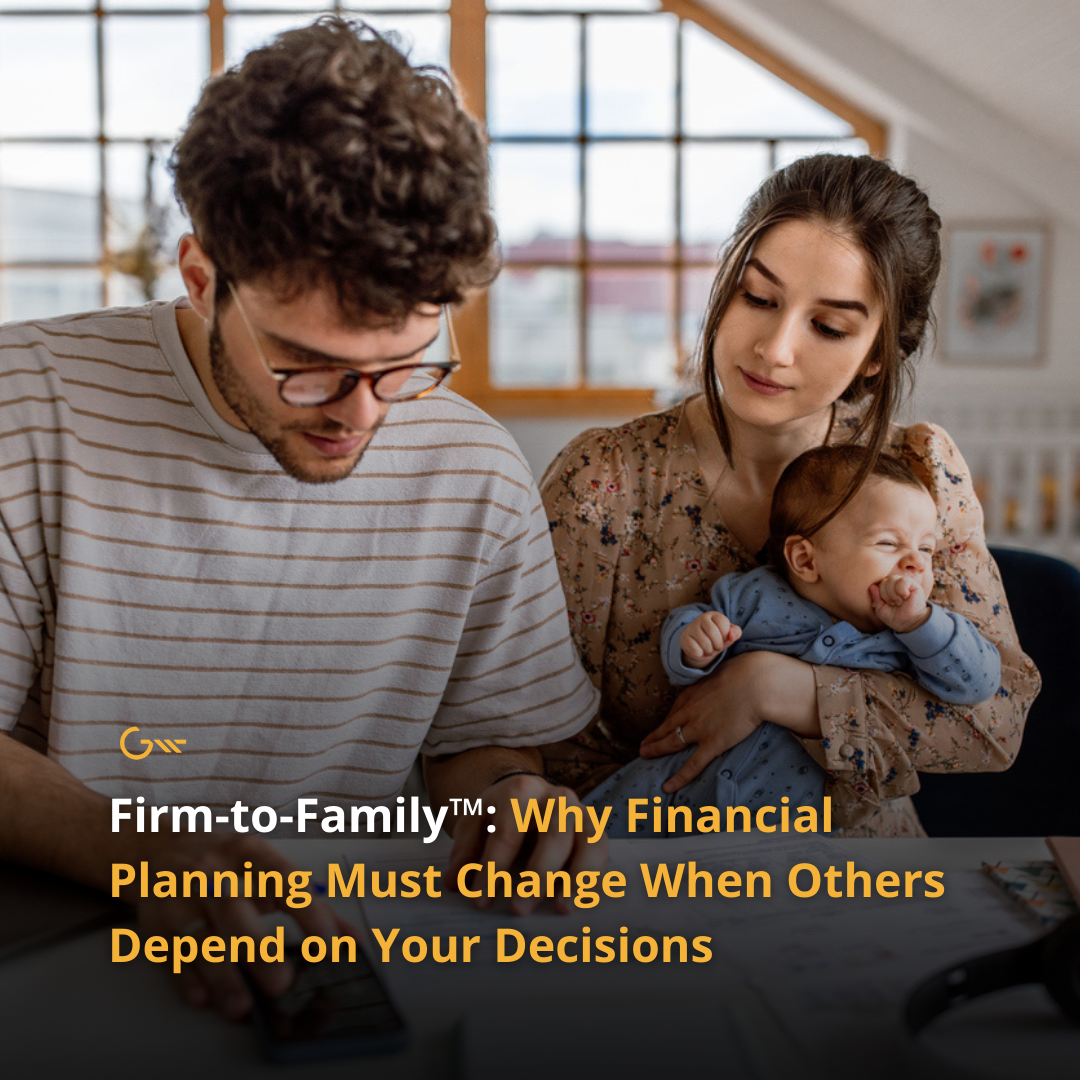
There comes a point when financial decisions stop being just about you.
What once affected only your lifestyle now reaches further—touching your spouse, your children, your employees, or the people who will inherit what you build. At that moment, financial planning feels different. The stakes are higher, the margin for error is thinner, and the consequences last longer.
Firm-to-Family™ reflects how financial planning must evolve when responsibility expands beyond the individual. It’s not a product or a service tier. It’s a structural response to the reality that planning for others requires more than good advice—it requires continuity, coordination, and durability over time.
What does the Firm-to-Family™ approach mean when you’re making financial decisions for others?
The Firm-to-Family™ approach reflects how financial planning should function when decisions affect more than one life. It emphasizes coordination across expertise, long-term perspective, and continuity of care—so decisions are made with the full picture in mind, not in isolation.
When responsibility extends beyond yourself, planning becomes less about individual optimization and more about alignment—for today, and for those who rely on you tomorrow.
Why Traditional Financial Planning Breaks Down
Traditional financial planning works well when decisions affect one person. Goals are clearer, timelines are shorter, and tradeoffs are easier to manage.
But as responsibility grows, complexity accelerates. Financial decisions begin to intersect across investments, taxes, business interests, retirement timelines, and family dynamics. Advice that isn’t coordinated starts to work against itself. A tax decision quietly undermines an estate plan. A liquidity choice creates strain elsewhere. Planning becomes fragmented, even when intentions are good.
The issue isn’t advisor competence. It’s structural fragility. Most planning models were never designed to hold together once multiple people—and multiple decades—are involved.
The Time Horizon Mismatch
Families think long-term. Often, they think in decades or generations.
Most advisory relationships do not.
Advisors operate on career-length timelines. Over time, they retire, change firms, sell their practices, or are acquired as part of broader industry consolidation. Private equity activity and book transitions have only accelerated this reality. Even well-managed relationships tend to expire within roughly plus or minus ten years of the client.
This creates a mismatch that rarely gets discussed: families plan across generations, while planning relationships are built around individual advisors with finite timelines. The result is an inherent continuity gap—one that grows more dangerous as responsibility increases.
The Hidden Risk of Advisor-Centric Models
When planning depends on a single advisor, that advisor becomes a single point of failure.
Context lives in one person’s head. Decisions rely on personal memory. Transitions—when they happen—are often rushed or incomplete. Even the best handoffs struggle to preserve intent, values, and long-term strategy.
Over time, families lose institutional memory. New advisors inherit data, but not understanding. Plans technically continue, but coherence slowly erodes.
Again, this isn’t a critique of individuals. It’s a limitation of advisor-centric design.
What Firm-to-Family™ Actually Means
Firm-to-Family™ represents a shift from individual-led planning to firm-led planning.
Instead of anchoring the relationship to one person, the relationship is anchored to a coordinated team within the firm. Context is shared. Responsibility is distributed. Continuity is designed into the structure, not dependent on personal longevity.
The client relationship belongs to the firm. The plan is supported by systems, specialists, and shared accountability. That’s what makes it durable.
How the Firm-to-Family™ Approach Works
In practice, the Firm-to-Family™ approach coordinates planning across the full picture:
- Investments and risk management
- Life stages and transitions
- Tax strategy and timing
- Long-term and generational outcomes
Rather than each discipline operating independently, decisions are made in context, with awareness of how one choice affects the whole. Standardized processes and repeatable deliverables ensure consistency, while shared responsibility reduces the risk of blind spots.
The goal is not complexity for its own sake. It’s clarity when complexity already exists.
Why This Was Traditionally a Family Office Model
The need for this approach becomes clearest during inflection points:
- Preparing for retirement while still supporting others
- Owning a business with employees and partners depending on outcomes
- Navigating succession, liquidity events, or inheritance
- Coordinating care and financial support for aging parents
In these moments, confidence doesn’t come from having more information. It comes from knowing decisions are aligned and supported over time.
Planning That Outlasts Any One Person
Advisor-centric models are fragile by nature. They rely on individuals, memory, and continuity that cannot be guaranteed.
Firm-to-Family™ is designed to endure. It acknowledges that families outlast advisors, that responsibility spans generations, and that stewardship requires a system strong enough to carry intent forward.
Because when financial decisions affect others, planning must do more than perform well today—it must hold up tomorrow, and for the people who come after.
The need for a coordinated, enduring approach becomes especially clear during key moments, including:
- Preparing for retirement while supporting family members
- Making business decisions that affect employees and partners
- Navigating liquidity events or leadership transitions
- Planning for inheritance, legacy, or multigenerational impact
- Coordinating care and financial support for aging parents
In these moments, confidence doesn’t come from having more information—it comes from knowing your decisions are aligned and supported across the full picture.
How can someone evaluate whether their financial decisions are truly coordinated?
Reviewing how investment, tax, retirement, and long-term planning strategies work together—and whether they reflect the needs of everyone impacted—can help identify gaps before they become problems. Planning for people means understanding not just what you’re deciding, but who you’re deciding for.
The Firm-to-Family™ Difference
At Gatewood, the Firm-to-Family™ approach is built for responsibility that lasts beyond any single advisor, decision, or life stage. It’s designed to support families and leaders through change, transition, and continuity—so the plan doesn’t depend on one person but endures for the people who matter most. This approach is managed by assigning full client care teams to the families we serve which creates a team that is familiar with each family’s goals to help serve them.
When financial decisions affect others, having a coordinated team behind you can make the difference between uncertainty and clarity.
Learn why our Firm-to-Family™ approach matters.
Important Disclosures:
Content in this material is for general information only and not intended to provide specific advice or recommendations for any individual. All investing involves risk including loss of principal. No strategy assures success or protects against loss.